Introduction
The equipment choice between tunnel washers and washer extractors shapes plant operations for 10–15 years. It determines water and energy costs, labor requirements, throughput capacity, and long-term profitability — which is why getting it wrong is expensive.
A facility processing 10,000 lbs/day could waste $50,000–$300,000 per year in unnecessary utility and labor costs with the wrong system in place. This guide breaks down the key differences between tunnel washers and washer extractors so you can match the right equipment to your operation.
TLDR: Tunnel Washers vs Washer Extractors
- Washer extractors: Batch machines for under 800 lbs/hour — lower upfront cost ($10–50K), higher water use (2.0–4.0 gal/lb)
- Tunnel washers: Continuous systems for 1,500+ lbs/hour — high capital cost ($250–500K+), but water use drops below 1.0 gal/lb
- Volume threshold rule: Under 5,000 lbs/day = washer extractors; Over 10,000 lbs/day with consistent flow = tunnel washers
- Key decision factors: volume consistency, floor space, labor costs, utility rates, and fabric variety
- Both systems carry a 10–15 year lifespan — your choice now locks in operating costs for well over a decade
Tunnel Washers vs Washer Extractors: Quick Comparison
The table below covers the key decision variables side by side — throughput, water use, cost, and fit.
| Feature | Washer Extractor | Tunnel Washer |
|---|---|---|
| Operation Type | Batch processing | Continuous flow |
| Ideal Throughput | Up to 800 lbs/hour | 1,500–3,300 lbs/hour |
| Water Usage | 2.0–4.0 gal/lb | 0.5–1.0 gal/lb |
| Capital Investment | $10–50K per unit | $250–500K+ system |
| Labor Requirements | Higher (manual load/unload) | Lower (automated) |
| Space Requirements | Flexible/modular | Large linear footprint (20–30 ft) |
| Best For | Variable loads and smaller facilities | High-volume consistent processing |
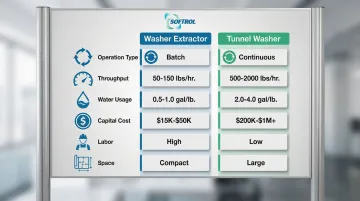
Note: Costs and specifications vary by manufacturer, capacity, and automation level. Consult equipment specialists for facility-specific recommendations.
What is a Washer Extractor?
Washer extractors are industrial batch-processing machines that wash and extract water from textiles in a single rotating drum. They operate similarly to large-scale commercial washers but with capacities ranging from 60–700 lbs per load, built for the demanding requirements of industrial operations.
The batch processing workflow is straightforward: goods are loaded, the machine runs through programmed wash/rinse/extract cycles (typically 30–60 minutes), then manually or semi-automatically unloaded before the next batch begins. This discrete processing approach gives operators precise control over each load's treatment.
Extraction method: Washer extractors use centrifugal force through high-speed spinning to push water out of fabrics against the drum wall. High-performance models generate 300–400 G-force during extraction, significantly reducing drying time and energy costs.
Capacity and configuration: Available in various drum sizes (100–600 lbs), washer extractors can be installed as standalone units or integrated into automated systems with conveyors and shuttles. Modern units offer programmable controls for different fabric types and soil levels. Softrol's MicroPulse controllers, for example, handle precise formula management and production data tracking across multiple machines.
Best fit for operations that:
- Process under 800 lbs/hour
- Handle varied fabric types requiring different wash formulas
- Need equipment redundancy to avoid single points of failure
- Experience fluctuating daily volumes
Advantages of Washer Extractor Systems
- Individual machines range $10–50K, allowing incremental expansion without a massive upfront commitment
- Run different wash programs simultaneously across multiple machines — useful for mixed loads of delicates, heavy linens, and specialized items in the same shift
- If one machine breaks down, others keep running — a single tunnel system failure halts entire production
- Each unit requires separate utility connections but offers modular placement flexibility within existing floor plans
Limitations of Washer Extractor Systems
- Typically use 2.0–4.0 gallons per pound of laundry — water reclamation systems can bring this below 2.5 gal/lb, but it remains higher than tunnel alternatives
- Requires staff to load and unload each machine multiple times per shift, which compounds labor costs at scale
- Multiple machines rarely exceed 800 lbs/hour due to batch cycle times and manual handling bottlenecks
- Repeated heating of fresh water for each batch drives up natural gas or electricity consumption
What is a Tunnel Washer?
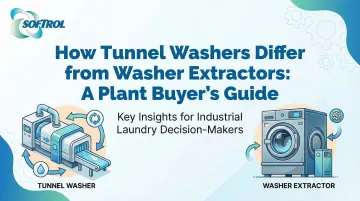
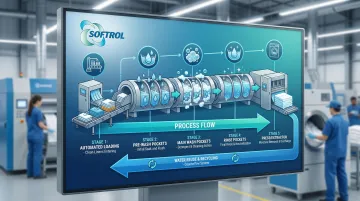
Tunnel washers — also called continuous batch washers (CBW) — are long horizontal systems with multiple compartments (pockets) where laundry moves through progressive washing stages via an internal auger. Goods enter one end, travel through pre-wash, main wash, and multiple rinse pockets, then exit to a press or centrifugal extractor. Typical systems contain 5-18 pockets, depending on capacity requirements and wash formula complexity.
A few key design features define how these systems work:
- Counterflow water system: Fresh water enters at the rinse stage and flows backward through wash zones, reusing progressively warmer, chemical-rich water where it's most effective. This allows water to be reused up to 3 times, cutting consumption significantly.
- Integrated components: A complete tunnel includes the washer (8-18 pockets), a press or centrifugal extractor at the discharge end, automated loading systems, and programmable controls for per-pocket formula management. Softrol's MicroPulse controls, for example, add formula tracking and real-time automation data at the pocket level.
- High throughput capacity: Systems handle 1,500-5,200+ lbs/hour, with batch sizes of 110-250 lbs cycling through at timed intervals.
Advantages of Tunnel Washer Systems
- Superior water efficiency: Use 0.5-1.0 gallons per pound—nearly two-thirds less than washer extractors—with counterflow design maximizing heat and chemical reuse
- Dramatic labor reduction: Automated loading and continuous flow eliminate repetitive manual handling; facilities report reducing staffing from 3 operators to 1 for the same throughput, saving approximately $75,000 annually
- Consistent high-volume throughput: Continuous operation provides steady workflow to downstream equipment (dryers, ironers), optimizing entire plant efficiency and preventing bottlenecks
- Lower total cost of ownership: Despite higher upfront costs, tunnels can operate at less than half the annual cost of comparable washer extractor systems
Limitations of Tunnel Washer Systems
- High capital investment: Complete systems typically cost $250,000-$500,000+, creating significant financial barrier and requiring careful ROI analysis based on volume projections
- Limited operational flexibility: Less adaptable to varied fabric types or short specialty runs; works best with consistent, uniform loads following standardized wash formulas
- Single point of failure risk: If tunnel system goes down, entire wash capacity halts (unlike washer extractor redundancy), though modern systems have high reliability with proper maintenance
- Space and infrastructure demands: Requires 20-30 linear feet, reinforced flooring for 10+ ton equipment, adequate drainage, and reliable steam/hot water supply
Tunnel Washer vs Washer Extractor: Which is Better for Your Plant?
Neither system is universally "better"—the right choice depends on matching equipment capabilities to your specific operational profile, volume patterns, and business model. Here's how to evaluate your situation.
Volume Assessment Framework
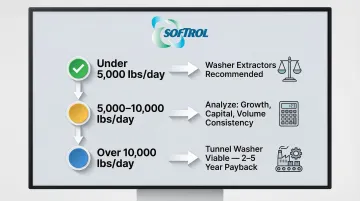
Under 5,000 lbs/day: Facilities processing below this threshold, especially with variable daily volumes, typically achieve better economics with washer extractor systems. The lower capital investment and operational flexibility outweigh the higher per-pound operating costs.
Over 10,000 lbs/day: Operations consistently processing this volume with predictable flow patterns can achieve payback on tunnel investment in 2-5 years through utility and labor savings. At 1,500+ lbs/hour, tunnels become the least expensive option to purchase and operate on a total cost basis.
The Middle Ground (5,000-10,000 lbs/day): Analyze your growth trajectory, available capital, and volume consistency. Facilities in this range should calculate specific payback periods based on their utility rates and labor costs to determine if tunnel investment makes sense or if washer extractors with water reclamation offer better value.
Operational Considerations Beyond Volume
Three factors beyond volume shape which system fits your plant:
- Fabric mix: Diverse load types—delicate hospitality linens, heavy industrial mats, healthcare textiles—favor washer extractor flexibility. Uniform loads like hotel sheets and towels suit tunnel systems well.
- Scheduling: Unpredictable incoming volumes favor batch flexibility. Plants with scheduled pickups and deliveries can optimize tunnel flow to match arrival patterns.
- Space and infrastructure: Tunnels require 20-30 linear feet, reinforced concrete pads (minimum 3,500 psi), 6-inch+ drain lines, and steam/hot water supply—constraints that often tip smaller plants toward modular washer extractor layouts.
Financial Analysis Framework
Calculate total cost of ownership over a 10-year equipment lifespan:
| Cost Category | What to Include |
|---|---|
| Capital | Equipment, installation, utility connections, facility modifications |
| Operating | Water, sewer, energy (gas/electricity), chemicals, labor, maintenance |
| Financing offsets | Equipment leasing, utility rebates for water-efficient equipment, phased rollout |
Example: A tunnel saving $100,000 annually against a $400,000 higher capital investment pays back in 4 years—delivering $600,000 in net savings over 10 years. Run the same math with your own utility rates and labor costs before committing.
Integration with Plant Automation and Controls
The equipment decision doesn't have to be all-or-nothing on efficiency. Control systems like Softrol's MicroPulse controllers and LOIS management software optimize performance across both equipment types through precise formula management and real-time monitoring.
Material handling, chemical dispensing, and garment tracking systems integrate with either platform—reducing labor, tightening workflow, and giving plant managers visibility into exactly where time and resources are going.
Real-World Application: When to Choose Each System
Choose Washer Extractors When:
- Your facility processes under 800 lbs/hour or has highly variable daily volumes fluctuating by 30%+ week-to-week
- You handle diverse fabric types requiring different wash formulas (mixed healthcare facility processing patient gowns, surgical linens, and bed sheets with varying soil levels)
- Equipment redundancy is critical and you cannot risk single-point-of-failure downtime
- Budget constraints limit capital investment to under $200K for wash equipment, or you prefer incremental expansion matching revenue growth
- Your facility lacks the linear floor space or structural support for tunnel installation
Choose Tunnel Washers When:
- Your facility consistently processes 1,500+ lbs/hour (10,000+ lbs/day) with predictable incoming flow and standardized textile types
- Utility costs (water, sewer, energy) are high in your region, making operating cost reduction a priority that justifies higher capital investment
- Labor costs are rising or staffing is difficult, and you need to maximize automation to maintain profitability
- You have adequate floor space (20-30 linear feet), structural support for heavy equipment, and necessary utilities (steam, drainage) already in place
- Your operation focuses on uniform goods like hotel linens, healthcare sheets, or uniform rental items
Hybrid Approach Consideration
Some large facilities use both equipment types to balance throughput with flexibility:
- Tunnel washers handle bulk, standardized items — sheets, towels, and healthcare flat goods
- Washer extractors handle specialty items — mats, uniforms with buttons or zippers, and delicate fabrics that need custom wash cycles or can't run through automated finishing lines
This split lets operations capture tunnel efficiency where volumes justify it, while keeping washer extractors available for goods that require individual handling.
For facilities running mixed equipment, Softrol's Total Plant Management system connects both tunnel washers and washer extractors under a single control framework. MicroPulse controllers and LOIS monitoring track production across equipment types in real time, so scheduling and throughput data stays consistent regardless of which machines are running.
Conclusion
The tunnel washer vs. washer extractor decision comes down to matching equipment capabilities with your facility's volume profile, operational needs, and financial resources. No single system wins across every scenario.
Before committing, work through each of these factors:
- Daily volume: Under 800 lbs/hour favors washer extractors; above 1,500 lbs/hour makes a tunnel viable
- Fabric mix complexity: Highly varied loads favor the flexibility of batch processing
- Capital and ROI timeline: Tunnel systems carry higher upfront costs with longer payback horizons
- Physical constraints: Tunnel installations require significantly more floor space and utility infrastructure
With proper maintenance, either system will define your plant's efficiency for the next 10–15 years. Run the numbers on your actual volume data before you commit.
Frequently Asked Questions
What is the difference between a tunnel washer and a washer extractor?
Washer extractors process laundry in batches—one load at a time in a rotating drum—while tunnel washers move linen continuously through multiple compartments. Tunnels offer higher throughput and lower per-pound operating costs, making them the preferred choice for high-volume facilities.
Is a washer extractor better than a washer?
In industrial laundry contexts, "washer" and "washer extractor" typically mean the same thing. Industrial washer extractors handle 60–700 lbs per load at 300–400 G-force extraction speeds, placing them in an entirely different category from residential machines.
Is a continuous batch washing machine the same as a washer extractor?
No. Continuous batch washers (tunnel washers) and washer extractors are different equipment types. Continuous batch systems move laundry through multiple compartments continuously with counterflow water systems, while washer extractors process discrete batches in a single rotating drum with manual loading/unloading between cycles.
How do I choose between a tunnel washer and a washer extractor?
Start with your consistent hourly volume. Facilities under 800 lbs/hour typically choose washer extractors; those processing over 1,500 lbs/hour with steady linen flow should evaluate tunnel washers. Factor in fabric variety, capital budget, and infrastructure constraints before committing.
How much does a commercial laundromat machine cost?
Commercial washer extractors range from $10,000–$50,000 per machine depending on capacity (60–700 lbs) and features. Complete tunnel washer systems typically cost $250,000–$500,000+ including installation, with the final figure driven by the number of pockets and how much press, conveyor, and sorting integration is included.