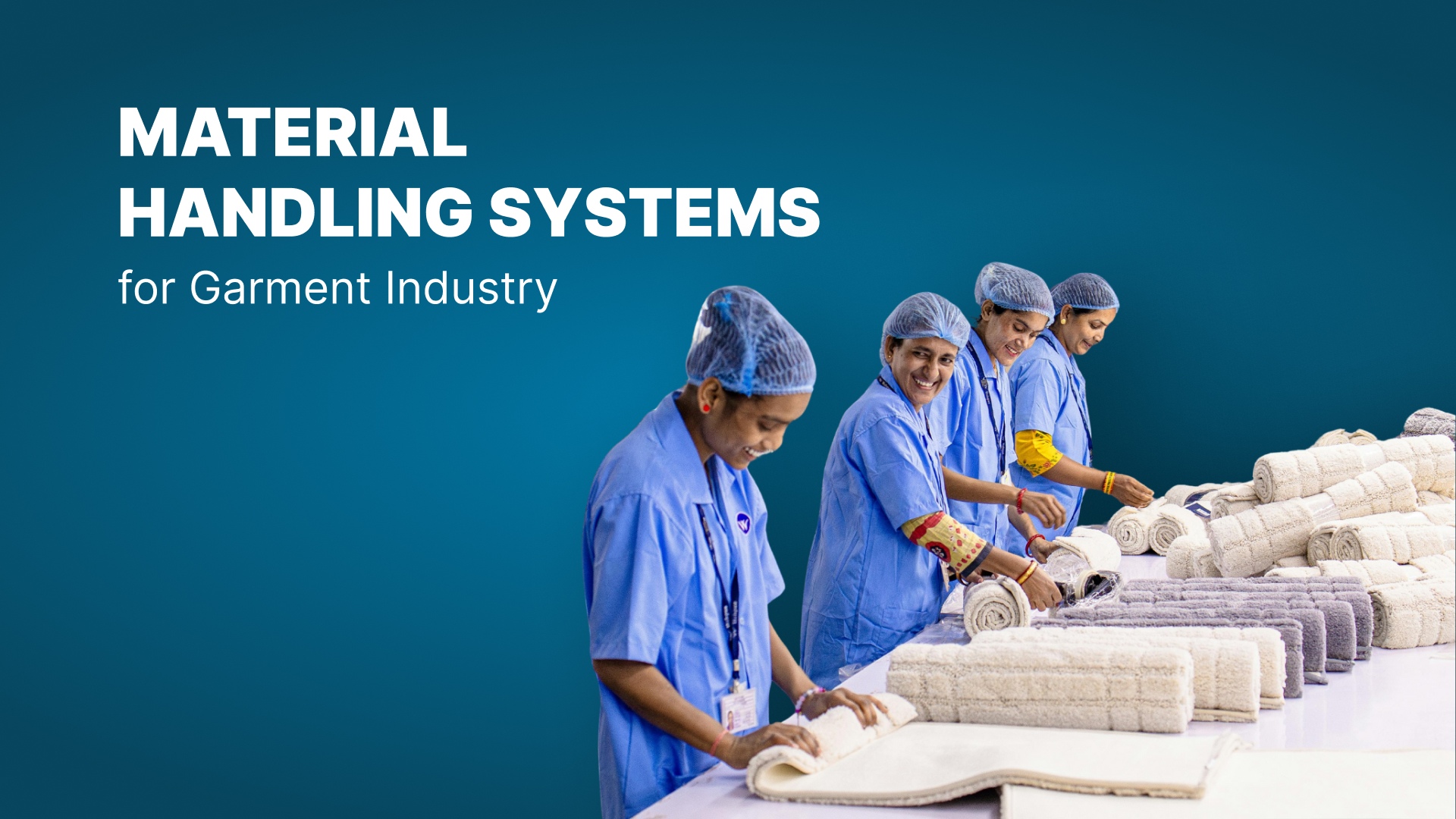
In the garment industry, managing the movement of fabric, garments, and materials can be a challenge. High-volume laundry facilities, garment rental companies, and textile plants all face issues with bottlenecks, space, and labor costs.
As the U.S. laundry market is expected to reach USD 20.62 billion by 2035, the need for better material handling systems has never been greater. Without efficient processes, operations can get slowed down, increasing costs and affecting quality.
Effective material handling can simplify the entire production flow, from fabric rolls to finished garments. In this blog, we will discuss how modern material handling systems can improve efficiency, reduce labor costs, and ensure faster, safer garment handling throughout your plant.
Overview
Effective material handling systems in the garment industry are essential for smooth production, reduced labor strain, and consistent throughput.
Automation, including roll handling, conveyors, and ergonomic tools, minimizes manual effort and operational delays.
Garment-on-Hanger (GOH) systems preserve garment quality, simplify sorting, and boost movement across departments.
Optimized storage, compact layouts, and custom-designed handling equipment maximize space and prevent workflow bottlenecks.
Integrated solutions like Softrol’s combine process control, real-time tracking, and analytics to deliver predictable, efficient, and cost-effective operations.
Defining Material Handling in the Garment Industry
Material handling in the garment industry refers to how fabric rolls, cut panels, garment bundles, and finished items move across cutting, stitching, finishing, and dispatch. It covers every action that keeps production flowing: lifting, storing, routing, sorting, and transporting materials. When these movements are smooth, operators work faster, equipment stays productive, and plants avoid unnecessary delays.
What material handling really ensures:
Smooth movement of fabric rolls from storage to cutting
Steady flow of cut parts to stitching lines
Predictable routing of stitched garments to finishing
Organized the transfer of finished items to packaging and dispatch
Minimal manual strain, reduced errors, and better process control
When these elements work together, plants avoid bottlenecks, reduce labor fatigue, and maintain consistent throughput across all departments. A clearer view of this becomes visible when we look at the specific handling equipment used in each department, which forms the foundation of the next section.
Also Read: Softrol’s Garment Sort Systems
Key Material Handling Equipment for Each Department
Each department faces different handling demands. Cutting teams work with bulky rolls, stitching lines depend on steady garment flow, and finishing areas require quick sorting and delivery. The table below shows how each department uses different systems to keep production predictable and efficient:
Department | Key Equipment | Primary Purpose | Operational Focus |
Cutting | Trolleys, roll carriers, hydraulic lifters, overhead/floor conveyors | Move fabric rolls from storage to the cutting tables | Ensure accurate placement, reduce manual effort, and maintain spreading quality |
Stitching | Overhead conveyors, garment rails, GOH systems, bundle trolleys, and RFID carts | Transport stitched panels and garments to stations | Maintain steady flow, prevent misrouting, support real-time tracking |
Finishing | Inspection tables, finishing stations, steam tunnels, automated sorters, storage rails, dispatch conveyors | Move garments through inspection, packaging, and shipping | Reduce congestion, enable quick sorting, and prepare items for dispatch efficiently |
This organized view highlights how each department uses tailored equipment to optimize workflow, laying the groundwork for addressing broader material handling challenges.
Major Challenges in Textile Material Handling
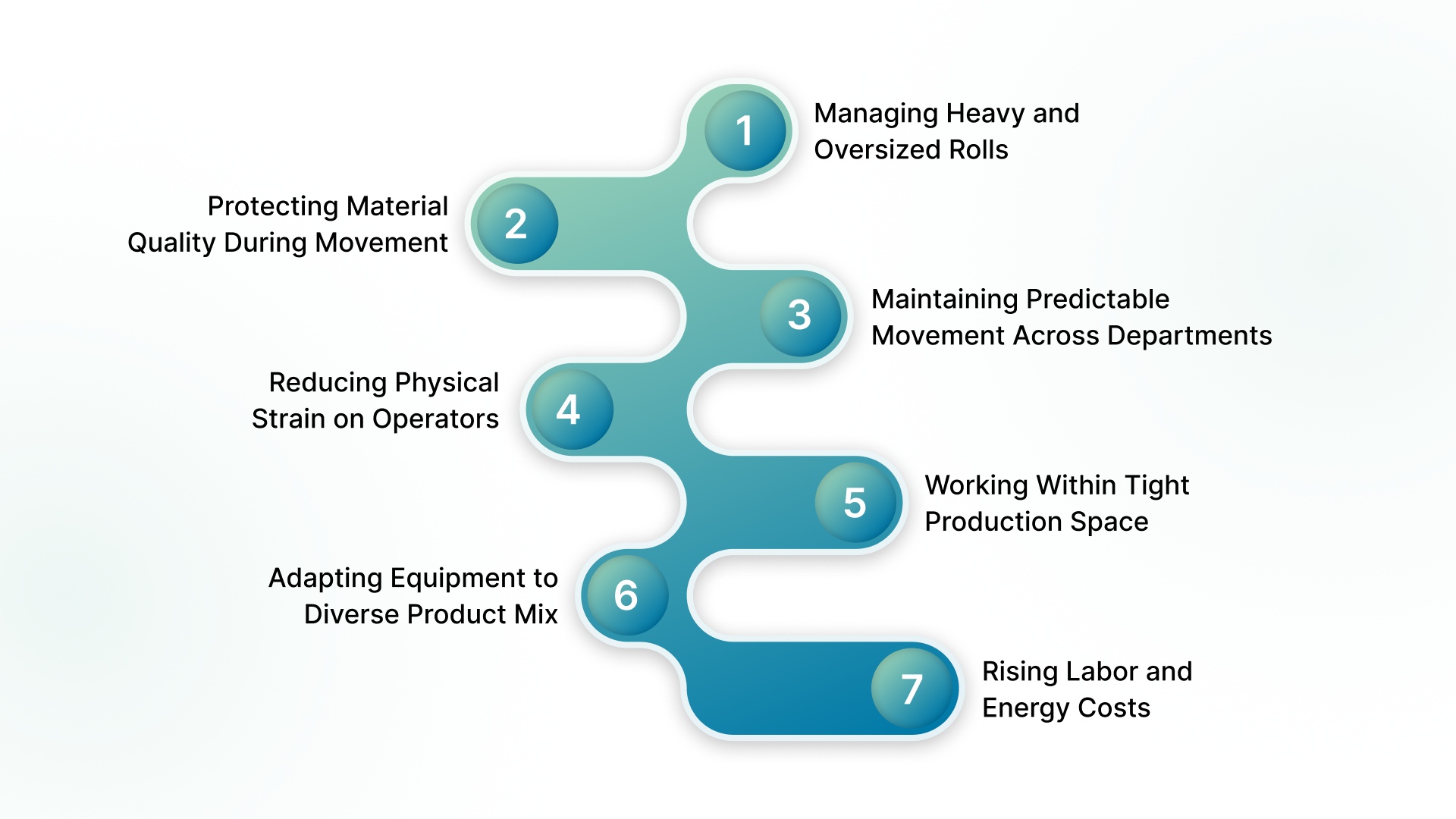
Material handling issues in garment and textile operations usually fall into operational, safety, and flow-related gaps. Below are the challenges that directly impact throughput, labor planning, and process reliability:
1. Managing Heavy and Oversized Rolls
Fabric rolls often exceed manageable weight and diameter, making them difficult to guide into position. Operators lose time during roll changeovers, and inconsistent handling slows upstream processes like spreading and batching.
2. Protecting Material Quality During Movement
In high-volume environments, fabrics face continuous contact with floors, trolleys, and dust-prone areas. Even minor contamination or creasing affects spreading tension, stitching accuracy, and finishing quality.
3. Maintaining Predictable Movement Across Departments
When garments or bundles move through narrow aisles or unstructured paths, flow becomes inconsistent. Some sections receive excess input while others wait, leading to imbalance across sewing, finishing, or wash–dry cycles. For example, soil carts reach sort stations in irregular bursts. This overwhelms sort operators while wash aisle pockets remain idle.
4. Reducing Physical Strain on Operators
Repetitive pulling, lifting, and pushing create fatigue, especially during long shifts. Plants see inconsistent performance because physical effort varies across operators and shifts, affecting takt time and equipment uptime.
5. Working Within Tight Production Space
Most units run at near-full capacity. Limited floor space forces rolls to be stored horizontally or along walkways, making retrieval slow and risky. Additionally, finished garments often accumulate in staging areas, blocking movement.
6. Adapting Equipment to Diverse Product Mix
Seasonal variations, SKU changes, and customer-specific workflows require flexible handling. Standard equipment cannot always support mixed fabric types, varying roll sizes, or different garment categories, causing ad-hoc fixes and inefficiencies.
7. Rising Labor and Energy Costs
Manual-intensive processes require more staff per shift. Repeated movements, idle travel, and equipment waiting time increase operational cost, making consistent scheduling more difficult. For example, two helpers escort every incoming fabric roll across long aisles, diverting manpower from stitching lines on high-volume days.
Addressing all of these challenges requires a handling approach that supports smoother flow, reduces manual dependency, and keeps production predictable. The next section breaks down practical, equipment-based solutions that plants can implement without disrupting existing operations.
Solutions to Address Material Handling Challenges
Resolving material handling inefficiencies requires targeted interventions that combine automation, ergonomic design, and optimized layouts. The following strategies help textile and garment operations increase throughput, reduce labor strain, and improve consistency:
1. Automated Roll Handling for Faster Preparation
Heavy fabric rolls slow production and risk operator injury. Automated lifters, motorized roll carriers, and guided positioning tools simplify movement from storage to cutting or spreading stations. Plants using automated transfer modules, like Softrol’s roll-handling components in soil-sort areas, report faster roll changes, smoother transitions, and fewer unplanned stoppages.
2. Organized, High-Density Storage for Better Material Control
Efficient storage improves retrieval speed and reduces errors. Vertical racking, compact shelving, and RFID or barcode tracking allow operators to identify which rolls or garments are available, in use, or reserved for upcoming batches. This structured approach maintains order, shortens search time, and supports consistent workflow across departments.
3. Conveyor and Rail Systems to Standardize Flow
Unstructured paths slow down material movement and create bottlenecks. Automated conveyors and overhead rails provide a predictable, continuous flow. For example, Softrol’s rail systems connect soil sort, wash aisles, and finishing area. It ensures garments move smoothly with minimal manual intervention and fewer workflow interruptions.
4. Ergonomic Tools That Reduce Operator Load
Manual handling strains workers and disrupts production. Electric trolleys, scissor lifts, and hydraulic assists reduce repetitive lifting and pushing. By stabilizing operator pace across shifts, these tools maintain consistent throughput and reduce fatigue-related errors.
5. Layout Optimization Using Space-Saving Modules
Plants often operate in constrained areas. Compact conveyors, foldable carts, and modular racks maximize usable space while minimizing congestion. This allows safer movement of rolls and finished garments, reduces delays in staging zones, and improves overall operational efficiency.
6. Tailor-Made Handling Systems for Specific Workflows
Generic equipment rarely fits high-volume or specialized garment operations. Custom GOH modules, adjustable rails, and specialized conveyors align with unique production patterns, batch sizes, and garment categories. Tailored solutions reduce changeover time, prevent misrouting, and ensure smooth transitions between departments.
7. Automation That Balances Cost and Performance
Manual processes and outdated equipment increase labor and energy costs. Low-energy motors, automated start–stop sequences, and integrated routing reduce unnecessary runtime. Plants benefit from predictable energy use, reduced utility bills, and consistent workflow, supporting both cost savings and higher output.
Implementing these solutions turns material handling bottlenecks into smooth, efficient processes. Next, we will explore Garment-on-Hanger (GOH) systems, which further organize garment movement and preserve quality in high-volume operations.
Also Read: Laundry Productivity Systems
The Role of Garment-on-Hanger Systems in Fashion Logistics
Garment-on-Hanger systems keep garments suspended, preventing creases, snags, or contamination. This is essential for high-volume laundries, uniform rental, and fashion distribution. Let’s understand what they are, how they work, and their various applications:
What is a GOH System?
A GOH system consists of automated rails, conveyor tracks, and sorting modules that transport garments directly on hangers. Each hanger follows a preprogrammed route from stitching, finishing, or cleaning to storage or dispatch. This reduces manual transfers and minimizes handling errors.
How Do GOH Systems Work?
Garments are loaded onto trolleys or hangers and travel along powered rails, passing through sorting stations. It automatically groups items by customer, size, or style. Integration with RFID or barcode systems allows real-time tracking, ensuring the right garment reaches the right location on time. For example, a uniform rental facility can process 5,000 uniforms daily while avoiding mix-ups or backlogs.
Why GOH Systems Matter in Fashion Logistics?
GOH systems simplify garment movement, cutting down manual handling and ensuring consistent quality. Key benefits include:
Reduced Labor Fatigue: Automated rails and hangers minimize repetitive lifting and carrying.
Lower Risk of Fabric Damage: Suspended transport prevents creases, snags, and contamination.
Faster Order Fulfillment: Garments move directly from finishing to storage or dispatch, speeding up delivery cycles.
Improved Accuracy: Sorting by size, color, or customer reduces errors and mix-ups.
Consistent Quality: Maintains garment presentation for retailers, rental operations, and high-volume laundries.
GOH in Different Applications
GOH systems are useful for garment movement across industries. Their versatility supports multiple operational needs, including:
High-Volume Laundries: Route uniforms and hotel linens efficiently, ensuring on-time delivery without rework.
Factories: Sort garments by batch, color, or size, maintaining organized production flow and minimizing errors.
Distribution Centers: Prepare ready-to-sell apparel for stores, boosting restocking and supporting smoother fashion logistics.
GOH systems’ ability to cater to various applications makes them a must for material handling requirements. This versatility becomes even more effective when paired with Softrol’s handling solutions. It helps organize garment flow and reduce manual touchpoints across departments.
How Softrol’s Solutions Address Textile Material Handling Needs?
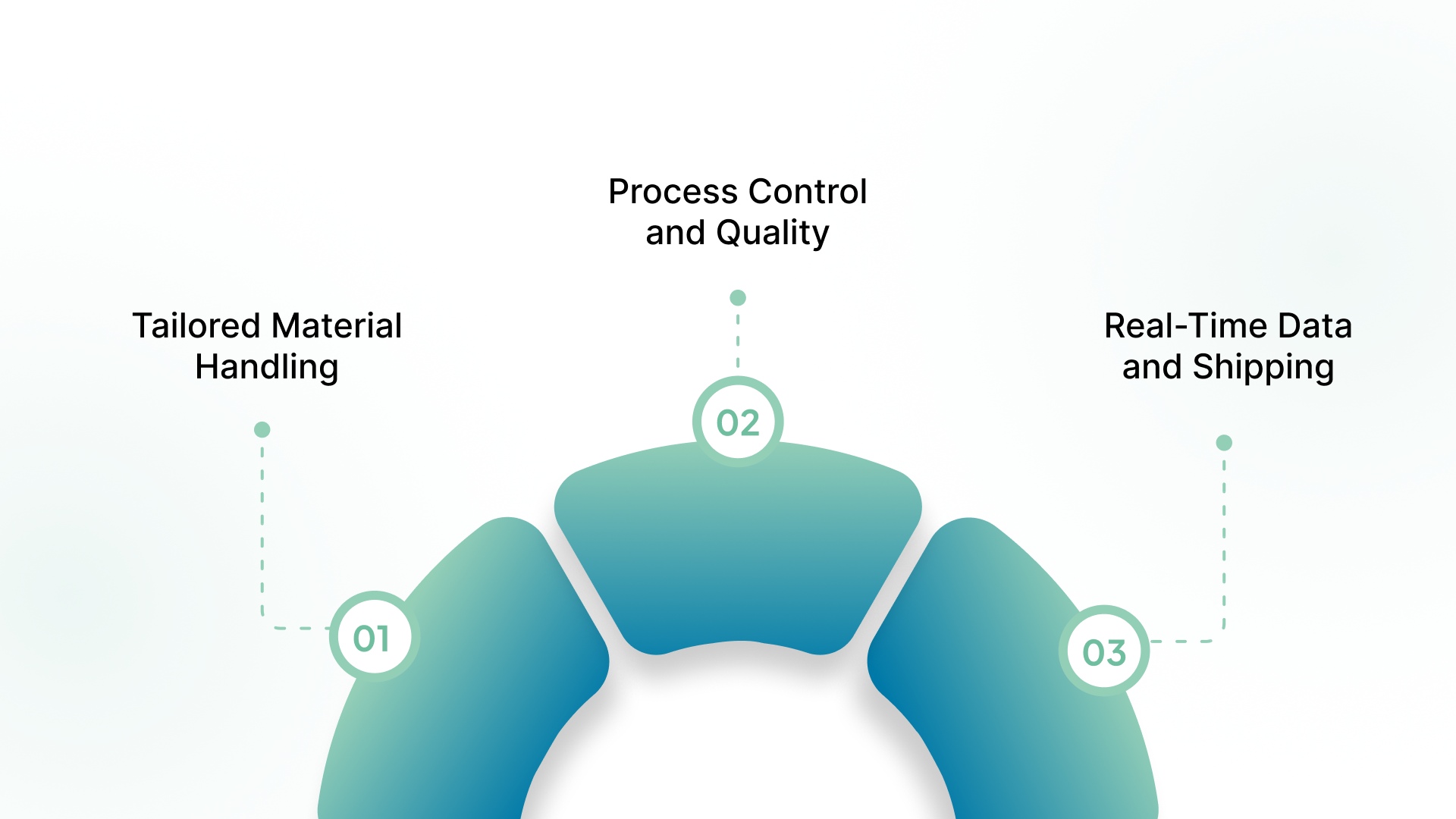
High-volume laundries and garment operations require speed, accuracy, and consistent quality. Softrol’s integrated systems are purpose-built for these environments, combining automation, process control, and real-time visibility to simplify almost every step of material handling. From soil sorting to finished garment dispatch, these solutions reduce labor dependency, stabilize workflow, and provide actionable insights that improve operational performance. Here’s how Softrol can help:
Tailored Material Handling
Softrol’s soil-sort systems, garment modules, and RFID rails align with plant workflows. Rail trolleys ensure smooth movement between soil sort, wash, and finishing, reducing bottlenecks and manual handling.
Process Control and Quality
Wash aisle systems and Catalyst Chemical Systems maintain consistent cycle parameters and precise chemical dosing. This minimizes rewash and ensures uniform treatment. Stable processes allow downstream finishing and packaging to operate efficiently without delays.
Real-Time Data and Shipping
PulseNet and LOIS provide managers with live production metrics and bottleneck alerts. Softrol’s shipping and tracking modules ensure every garment reaches the correct destination, reducing errors, improving on-time delivery, and enhancing operational reliability.
By integrating material handling, process control, and analytics, Softrol transforms operations into predictable, efficient, and cost-effective workflows.
Also Read: Softrol Systems: Providing a Total Plant Management Solution
Conclusion
Effective material handling is essential for high-volume garment and laundry operations. Optimizing movement, storage, and workflow reduces labor strain, prevents damage, and ensures consistent throughput. Addressing challenges like bulky rolls, irregular flow, and limited space allows plants to operate safely, efficiently, and predictably.
Besides, Softrol’s solutions enhance material handling by combining automation, process control, and real-time visibility. Systems like soil-sort modules, RFID-enabled rails, and reporting platforms manage operations, reduce errors, and provide actionable insights. This ensures garments move efficiently, safely, and reliably from start to dispatch.
To enhance your operations and achieve predictable, efficient workflows, explore Softrol’s integrated material handling solutions today. Contact us now and take the first step toward smarter plant management!
FAQs
1. What is the 7-point system in the garment industry?
The 7-point system is a fabric and garment inspection method that checks seven key quality elements. This includes fabric, color, accessories, workmanship, measurement, labeling, and packing. Doing this ensures products meet required standards before moving to production or shipment.
2. What are the types of systems used in the garment industry?
Common systems include bundle system, progressive bundle system, unit production system (UPS), modular system, overhead conveyor systems, and GOH handling. These simplify material movement, reduce labor dependency, and support continuous, balanced workflow across production stages.
3. What is a unit production system in apparel manufacturing?
A unit production system transports individual components automatically through sewing stations using overhead rails. It reduces manual handling, improves line balance, speeds up throughput, and ensures each piece follows a defined, error-free sequence.
4. What is inline quality inspection in garment production?
Inline quality inspection checks garments during sewing rather than after completion. Inspectors catch defects early, reduce rework, maintain consistent quality, and prevent defective pieces from moving further along the production line.