
Introduction
Plant managers face mounting pressure to justify automation investments while labor costs climb 10-15% annually and skilled workers become increasingly scarce. With median hourly wages for laundry workers now at $14.93 and nearly 75% of industry professionals citing "finding reliable labor" as their top challenge, automation has shifted from optional upgrade to strategic necessity.
That pressure to act doesn't make the decision easy. ROI on laundry automation varies dramatically based on plant size, current processes, automation type, and whether you account for soft benefits like quality improvements and safety gains.
A sorting system in a high-wage market might pay back in 18 months. The same technology in a low-cost region could take 36+ months.
This guide provides a step-by-step framework for calculating ROI, identifying the right data inputs, avoiding common calculation errors, and presenting results that get buy-in from leadership. That includes how to validate vendor claims and determine when automation makes financial sense for your operation.
Key Takeaways
- Start with 3-6 months of baseline data: labor hours, throughput, error rates, and operating costs
- ROI = total savings (labor, capacity, rewash, injury costs) minus total investment (equipment, installation, training, maintenance)
- Most laundry automation delivers 18-36 month payback periods, but results depend on accurate data and realistic productivity assumptions
- Key variables: labor rates, plant utilization, automation type, and available capacity to sell
How to Calculate ROI on Laundry Plant Automation
Step 1: Establish Your Baseline Metrics
Start by documenting current performance across the specific process you're considering automating. Without accurate baseline data, your ROI calculation becomes guesswork.
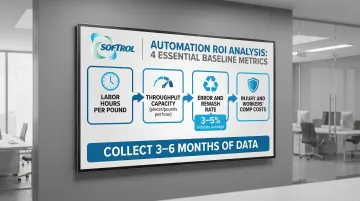
Essential baseline metrics include:
- Track total direct labor hours divided by pounds processed for the targeted area (labor hours per pound processed)
- Document current pieces per hour or pounds per hour during normal operations (throughput capacity)
- Measure what percentage of loads require reprocessing — industry average runs 3–5% (error and rewash rates)
- Record incident rates and associated costs for the department (injury and workers' comp costs)
Collect data for at least 3–6 months to account for seasonal variations. A single week of best-case performance doesn't reflect reality. According to industry best practices, documenting every wash cycle for at least 30 days during normal operations establishes accurate volume analysis.
Cross-check your numbers against TRSA or Clean Show benchmarks to confirm genuine improvement opportunity exists. If your facility achieves 75 Pounds Per Operator Hour (PPOH) for hand-folding, you're hitting reasonable expectations — automation should push that number significantly higher.
Step 2: Calculate Total Investment Costs
Sum all upfront and ongoing costs to determine true cost of ownership.
Upfront costs:
- Equipment purchase price (request itemized quotes from vendors)
- Installation and integration expenses ($1,000–$5,000 per machine for standard units, higher for complex systems)
- Facility modifications (electrical upgrades, concrete pads, ventilation)
- Initial training costs for operators and maintenance staff
Ongoing costs:
- Annual maintenance contracts (typically 15–20% of original hardware cost)
- Software licensing fees (if applicable)
- Spare parts inventory (budget approximately 10% of hardware costs annually)
- Additional utility consumption (electricity, water, gas)
Factor in financing costs if you're not paying cash upfront — terms and interest rates affect true cost of ownership. Professional integrators typically charge $100–$200 per hour for complex industrial automation projects.
Step 3: Quantify Expected Savings and Benefits
Vendor projections skew optimistic. Here's how to build your own numbers.
Direct labor savings:
Calculate current labor hours for the targeted process, then multiply by fully-loaded labor rates. "Fully-loaded" means wages plus benefits, payroll taxes, and workers' comp, typically 1.4–1.6x base wages. If automation reduces sorting from 5 operators to 2, and your fully-loaded cost is $22/hour, annual savings equal: (3 operators × $22/hour × 2,080 hours) = $137,280.
Capacity gains:
Determine additional throughput automation enables, then multiply by gross margin per pound. Only count this if you have customers to fill the capacity. A 25% throughput increase means nothing if you're already running at 60% utilization with no growth prospects.
Quality and safety improvements:
Research shows TRSA members reduced their Total Recordable Incident Rate (TRIR) by 40.7% from 2019–2023 through automation and safety programs. Lower injury rates reduce workers' comp premiums. Reduced rewash rates (from 4% to 2%, for example) free up capacity without additional capital investment.
Soft benefits:
- Calculate turnover costs (recruiting, onboarding, and lost productivity during ramp-up) to quantify the value of improved retention
- Estimate what consistent quality is worth in customer retention — even avoiding one lost contract per year moves the needle
Step 4: Apply ROI Calculation Formulas
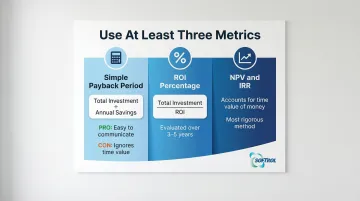
No single metric captures the full picture — use at least three.
Simple payback period:
Divide total investment by annual net savings. If you invest $500,000 and save $200,000 annually, payback is 2.5 years. This metric is easiest to understand but ignores the time value of money.
ROI percentage:
Calculate as [(Total Savings Over Period - Total Investment) / Total Investment] × 100. Evaluate over 3–5 years. If your 5-year savings total $1,000,000 against a $500,000 investment, ROI = [($1,000,000 - $500,000) / $500,000] × 100 = 100%, or 20% annually.
Net Present Value (NPV) and Internal Rate of Return (IRR):
These metrics account for the time value of money, which simple payback ignores. NPV calculates the present value of all future cash flows minus the initial investment. A positive NPV means the project clears your hurdle rate. IRR shows the discount rate at which NPV equals zero — projects with IRR above your cost of capital generally clear the investment bar.
Step 5: Validate Assumptions and Conduct Sensitivity Analysis
Even well-built models have blind spots. Stress-test yours before presenting to leadership.
Sensitivity analysis:
Vary key assumptions to understand which factors most impact results. What happens if labor rates increase only 5% instead of 10%? What if productivity gains reach only 70% of projections? Build scenarios showing pessimistic, realistic, and optimistic outcomes.
Vendor validation:
Request customer references at similar operations and actual performance data from existing installations. Visit sites if possible. According to industry case studies, one facility achieved a 77% labor reduction with automated sorting, while another reduced their workforce by 70%. Those real-world results are your best check against vendor projections.
Contingency planning:
Build in contingency factors for implementation delays, learning curve periods, and unexpected integration challenges. Experts recommend a 10–15% contingency budget for unforeseen costs during implementation.
When Should You Calculate ROI for Automation
ROI analysis delivers the most value when facing specific operational triggers.
Primary triggers include:
- Chronic staffing gaps that leave shifts unfilled or understaffed
- Throughput ceilings forcing you to turn away new business
- Recurring quality or delivery complaints tied to manual process variability
- Lost bids to competitors with lower labor costs from automated operations
Once you've identified these triggers, timing your analysis to the capital approval cycle matters just as much. Calculate ROI during budget planning cycles — typically 6-12 months before your fiscal year begins. This gives you time to build a solid business case, secure multiple vendor quotes, and address leadership questions.
ROI calculations become less reliable for highly customized installations, very small operations where fixed costs dominate, or when baseline data is poor or inconsistent. In these cases, prioritize improving your data collection before running the numbers.
What You Need Before Calculating Automation ROI
Before any ROI calculation is worth presenting, you need clean, systematically collected baseline data. Estimates built on guesswork rarely survive budget review.
Current Performance Data Requirements
Specific metrics needed:
- Labor hours by process area (washing, drying, sorting, finishing)
- Pieces processed per hour or pounds per hour
- Rewash percentages and reasons for reprocessing
- Injury incident rates and workers comp claims history
- Current equipment utilization rates
How to collect this data:
Conduct time studies if you lack historical records. Use production logs, LIMS/ERP system reports, and workers comp claims documentation.
Plant management systems like Softrol's LOIS (Laundry Operation Information System) can accelerate this process by tracking Pounds Per Operator Hour (PPOH), machine utilization, and throughput continuously — making your ROI case more credible to stakeholders.
Financial Information and Cost Data
Gather fully-loaded labor costs for every affected position. Base wages alone understate true savings. Include:
- Payroll taxes (7.65% FICA minimum)
- Benefits (health insurance, retirement contributions)
- Workers comp insurance
- Turnover and training costs
Research current throughput revenue and gross margins to quantify capacity gains. For example, processing 100,000 pounds monthly at $0.50 gross margin per pound means a 20% capacity increase could add $10,000 in monthly margin — but only if customer demand supports it.
Gather utility rates (electricity, water, gas) if automation changes consumption patterns. Some automation reduces water and chemical usage, while other systems increase electricity consumption.
Vendor Specifications and Performance Guarantees
Request detailed specifications showing expected throughput rates, labor requirements, and typical productivity improvements. Ask for customer references at similar operations and actual performance data from existing installations.
Clarify what's included in equipment pricing versus additional costs. Installation, training, integration with existing systems, and ongoing support often appear as separate line items that can significantly shift total investment.
Key Parameters That Affect Automation ROI Results
Small changes in key assumptions can dramatically shift ROI outcomes. Understanding which parameters matter most helps you focus data collection and negotiate with vendors.
Current Labor Costs and Availability
Higher labor costs and severe shortages dramatically improve automation ROI. With median wages for laundry workers at $14.93/hour and supervisors at $23.23/hour, regions with higher minimum wages or union density see faster payback periods.
Fully-loaded labor costs — including benefits, taxes, and turnover — run 1.4-1.6x base wages. Using base wages alone understates true savings by 30-40%. Material handling positions, with a median wage of $16.45/hour, follow the same pattern: the fully-loaded number is what makes automated rail and conveyor systems pencil out.
Plant Utilization and Volume
Automation ROI improves with higher throughput volumes because fixed equipment costs spread across more units processed.
Plants running below 70% capacity may struggle to justify automation. The equipment sits idle during non-peak periods, and you're paying maintenance costs on underutilized assets. Plants at 90%+ utilization see automation unlock growth—the equipment runs continuously, maximizing return on investment.
Automation Type and Complexity
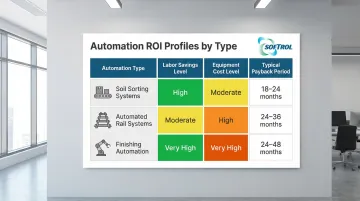
Different automation types deliver different ROI profiles:
- Soil sorting systems - High labor savings, moderate equipment cost, typically 18-24 month payback
- Automated rail systems - Moderate labor savings, high equipment cost, typically 24-36 month payback
- Finishing automation - Very high labor savings, very high equipment cost, typically 24-48 month payback
Simpler, modular automation often delivers faster ROI than complex, fully-integrated systems. Softrol's modular sorting systems, for example, allow phased implementation that reduces upfront investment while delivering immediate labor savings.
Capacity Gains and Revenue Opportunity
Added throughput only generates value when customer demand exists to absorb it. One facility grew production 90% over four years through stepped automation — but that required matching business growth at every stage.
To quantify capacity gains realistically:
- Multiply additional pounds processed by gross margin per pound
- Discount the result by your confidence level in securing that volume
- If you're 95% confident you can fill the capacity, use 95% of the calculated revenue opportunity
Soft Benefits and Risk Reduction
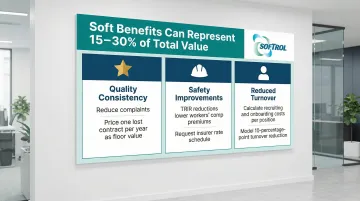
Conservative ROI calculations often exclude soft benefits, but they can represent 15-30% of total value in healthcare and hospitality laundries.
These benefits are quantifiable with the right inputs:
- Quality consistency - Fewer customer complaints and stronger contract retention; price one lost contract per year to set a floor value
- Safety improvements - TRIR reductions translate directly into lower workers' comp premiums; request your insurer's rate schedule to model savings
- Reduced turnover - Calculate recruiting, onboarding, and productivity ramp-up costs per position, then model a 10-percentage-point reduction in annual turnover rate
Common Mistakes When Calculating Automation ROI
Avoid these calculation errors that lead to disappointing results.
- Vendor ROI projections use best-case scenarios. Validate every assumption against your actual baseline data and call their customer references before accepting any numbers.
- Comparing equipment cost only to labor savings leaves out maintenance (15-20% of hardware cost annually), software licensing, and integration fees — costs that can cut net savings substantially, as outlined in Qviro's implementation cost benchmarks.
- Productivity typically dips before it rises. Budget for a 3-6 month transition period where manual and automated processes run in parallel, and factor that overlap into your timeline.
- Capacity gains only count if you can sell the throughput. Don't credit additional output as savings without realistic demand forecasts to back it up.
Troubleshooting Issues in ROI Calculations
Even a carefully built ROI model hits snags. Once you've run your numbers, these are the four problems plant managers encounter most often — and how to work through each one.
Problem: Baseline Data Is Inconsistent or Incomplete
Conduct focused time-and-motion studies for 2-4 weeks to build a reliable baseline when historical data is thin. If plant-specific data simply isn't available, industry benchmarks from TRSA, Clean Show research, or equipment vendors serve as reasonable proxies to get your model started.
Projected Savings Look Too Good to Be True
Apply a conservative adjustment: reduce vendor-projected savings by 20-30% to account for real-world implementation friction. Then go a step further — request customer references and schedule site visits to see how actual performance compares to what was promised on paper.
Problem: Leadership Questions Your Assumptions
Build a sensitivity analysis that models ROI under three scenarios: pessimistic, realistic, and optimistic. Presenting a range of outcomes — rather than a single-point estimate — shows leadership you've thoroughly pressure-tested your assumptions and aren't anchored to a best-case number.
Problem: Competing Projects Make Automation Look Less Attractive
Compare automation ROI against other capital investments using consistent metrics — NPV and IRR — rather than mixing simple payback calculations with more rigorous measures. Keep in mind that automation often carries strategic value that pure financial ROI doesn't capture: competitive positioning, evolving customer requirements, or enabling volume growth that manual processes simply can't sustain.
Alternative ROI Calculation Approaches for Laundry Automation
Different stakeholders prefer different ROI frameworks. CFOs want NPV/IRR, operations leaders focus on payback period, and executives consider strategic fit.
Simple Payback Period Method
Divide total investment by annual savings to get years until breakeven. If you invest $300,000 and save $150,000 annually, payback is 2 years.
This method works best for quick screening of smaller automation projects — generally under $100,000 — where a full financial model isn't warranted. It's the easiest approach to communicate upward, though it has two real limitations: it doesn't account for the time value of money, and it ignores returns that accumulate after breakeven.
Total Cost of Ownership (TCO) Comparison
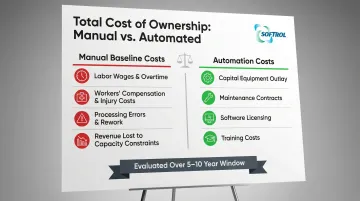
TCO maps every cost on both sides of the decision over a 5–10 year window. For the manual baseline, that includes:
- Labor wages and overtime
- Workers' compensation and injury costs
- Processing errors and rework
- Revenue lost to capacity constraints
Against that, you project all automation costs: capital outlay, maintenance contracts, software licensing, and training. TCO is especially useful when ongoing software or controls costs are material — which they often are in laundry plant automation. It gives you the most complete financial picture, though it requires solid cost tracking to build accurately.
Not every value driver shows up in a TCO model, however.
Strategic Value Assessment
Pure financial ROI understates value in certain situations:
- Automation required to win or retain major contracts
- Competitive positioning in labor-scarce markets
- Enabling growth that manual processes cannot support
For major investments, pair the financial model with an honest read on strategic fit. A 3-year payback that locks in a key customer relationship or opens capacity for new routes can outperform a 2-year payback on a project that solves a narrow, low-stakes problem.
Conclusion
A credible ROI case requires rigorous baseline data and conservative assumptions — while honestly acknowledging that some benefits, like reduced supervisor stress or faster customer response, won't appear in a spreadsheet.
Most automation investments that underperform trace back to one of three root causes:
- Weak baseline data — numbers estimated rather than measured before installation
- Inflated productivity assumptions — projecting peak performance instead of realistic ramp-up
- Underestimated implementation friction — staff training time, workflow disruption, and integration delays
The ROI methodology rarely fails. The inputs do.
Start with smaller, modular automation projects that deliver quick ROI and build internal expertise before tackling complex, plant-wide automation initiatives. A well-executed garment sorting system, for example, gives you actual throughput and cost figures — the kind of grounded evidence that makes board approval for a full rail automation project far more straightforward.
Frequently Asked Questions
What is the ROI of laundry plant automation?
Typical laundry automation delivers 18-36 month payback periods with 30-60% annual ROI. Results vary widely based on plant size, current labor costs, automation type, and how thoroughly you account for capacity gains and quality improvements.
How long does it take for laundry automation to pay for itself?
Simpler automation like sorting systems often pay back in 12-24 months, while complex finishing automation may take 24-48 months. Faster payback comes from high-volume operations in expensive labor markets.
What metrics should I track to calculate automation ROI accurately?
Track current labor hours by process, throughput per hour, rewash rates, injury incidents, equipment utilization, and fully-loaded labor costs including benefits and turnover expenses.
Should I include labor savings in my ROI calculation even if I don't eliminate positions?
Yes. Moving workers off repetitive tasks creates real value — they can handle volume growth, improve quality control, or allow you to avoid new hires as demand increases. Each scenario represents a tangible cost offset.
What's a good ROI percentage for laundry automation investments?
Here's a quick reference for benchmarking your results:
| Annual ROI | Payback Period | Assessment |
|---|---|---|
| 40%+ | Under 2.5 years | Excellent |
| 25–40% | 2.5–4 years | Good |
| Below 20% | 5+ years | Marginal — only justifiable with strong strategic upside |
How do I account for increased capacity in ROI calculations?
Capacity gains only count if you have demand to fill them. Multiply the additional pounds you can process by your gross margin per pound, then weight that figure by the realistic probability of winning the business before including it in your ROI model.