Introduction
A mismatched laundry management system doesn't just underperform—it creates cascading problems across your entire plant. Equipment that fails to communicate triggers downtime. Documentation gaps expose healthcare facilities to HLAC compliance penalties. Automation that never delivers on its promises locks in the labor costs you were trying to cut. With 75% of industrial laundry operators citing labor costs or staffing challenges as their top operational concern, the stakes of getting this decision wrong are measurable.
Plant operators in healthcare, hospitality, and uniform services face challenges that consumer laundromat software simply wasn't built to handle. Industrial plants process thousands of pounds per hour across multiple wash aisles, manage compliance documentation for HLAC accreditation, and coordinate material flow through overhead rail networks and automated sorting systems.
That scale demands purpose-built systems—ones that integrate hardware and software across the full production workflow, not just one corner of the plant.
This guide helps you evaluate vendors on the metrics that matter: cost per pound processed, on-time delivery rates, and equipment utilization—so you can make a selection your plant won't outgrow.
Key Takeaways
- Laundry management systems automate material handling, process control, and data tracking from intake through delivery
- Key benefits include 30–77% labor reduction, real-time plant visibility, and automated compliance documentation
- Prioritize scalability, RFID tracking, and equipment integration when evaluating vendors — most plants target 18–36 month ROI
- Softrol's LOIS platform gives plant operators remote access to real-time performance data, backed by 35+ years in industrial laundry automation
What is a Laundry Management System for Industrial Plants?
An industrial laundry management system combines software and hardware to automate and optimize the entire workflow from soil sort to clean garment delivery. These systems control material movement through conveyors and overhead rail networks, manage wash formulas and machine sequencing, track individual garments via RFID technology, and provide centralized dashboards that aggregate real-time performance data from all equipment stages.
Unlike consumer laundromat software focused on point-of-sale transactions, industrial systems manage plant-scale volumes, integrate with tunnel washers and automated finishing equipment, maintain compliance documentation for healthcare regulations, and provide multi-location management capabilities. The difference is operational scope—consumer systems handle individual customer transactions, while industrial platforms orchestrate production logistics for facilities processing 2,000+ pounds per hour.
Core Components of Industrial Laundry Management Systems
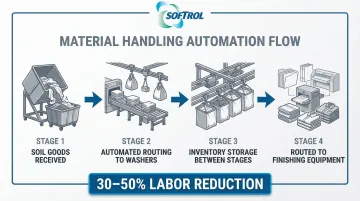
Material Handling Automation
Automated conveyor systems and overhead rail networks move textiles through the plant without manual handling. Key components include:
- High-speed cart dumpers that process soiled goods at intake
- Automated sling transfer systems that route loads to tunnel washers
- Overhead storage rails that buffer inventory between processing stages
- Automated delivery systems that route clean goods to finishing equipment
This reduces manual labor requirements by 30-50% and prevents the bottlenecks that develop when hand-off between stages can't keep pace with machine throughput.
Process Control Systems
PLCs (Programmable Logic Controllers) integrate with washers, dryers, and finishing equipment to standardize quality and optimize resource use. They handle:
- Wash formula accuracy through precise chemical injection timing and dosage
- Water and energy consumption via temperature and cycle controls
- Machine sequencing to maintain continuous flow through the wash aisle
- Processing data handoffs between controllers, traveling with each load
Every batch receives the correct treatment, and the data trail supports quality troubleshooting when issues arise.
Data Integration and Reporting
Centralized dashboards pull real-time data from every equipment stage into a single interface. Plant managers can:
- Monitor machine uptime and catch equipment failures immediately
- Track production rates against target throughput
- Measure employee productivity in pounds per operator hour (PPOH)
- Generate compliance documentation automatically for regulatory audits
That visibility shifts operations from reactive firefighting to proactive management—spotting a developing bottleneck before it shuts down a production line.
Benefits of Modern Laundry Management Systems
Reduced Labor Costs
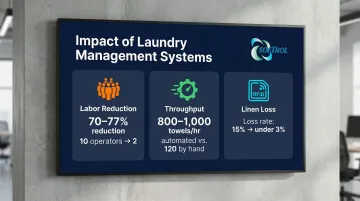
Automation eliminates manual handling, sorting, and tracking tasks that once consumed the bulk of workforce hours. Facilities implementing automated sorting systems have documented labor reductions from 70-77%, consolidating crews from 10 operators down to 2 while maintaining or increasing throughput. Plant operators can reallocate staff from repetitive material handling to higher-value activities like quality control, customer service, and equipment maintenance.
Improved Operational Efficiency
Real-time visibility into machine status, order progress, and bottlenecks allows managers to optimize throughput immediately rather than waiting for end-of-day reports. Automated systems process 800-1,000 towels per hour compared to 120 by hand, and facilities have achieved throughput increases of 30% while reducing labor costs by 25-30%. Cycle time reductions and continuous flow designs eliminate the dwell time between stages that occurs with manual batch handling.
Enhanced Compliance and Quality Control
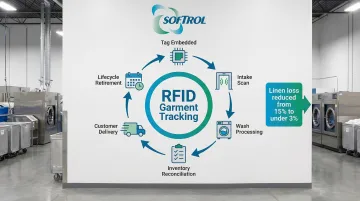
Automated tracking and documentation help facilities meet healthcare regulations like HLAC accreditation requirements, customer SLAs demanding 98%+ on-time delivery, and quality standards that limit rewash rates to under 3%. Systems automatically log wash cycle parameters—temperature, time, chemical dosage—to prove hygienically clean standards were met for every batch. RFID tracking has reduced linen loss rates from 15% to under 3% in healthcare facilities, providing both inventory security and audit-ready documentation.
Critical Factors to Consider When Choosing a Laundry Management System
Selecting the right system requires aligning technical capabilities with your plant's specific operational goals, current scale, and growth plans. Each factor below maps directly to measurable KPIs: cost per pound processed (target: $0.73-$0.99), on-time delivery rates (target: ≥98%), and equipment utilization percentages.
Scalability and Multi-Location Support
Your system must handle current volume while accommodating future growth—new customers, additional plants, or expanded services. Plants processing 5,000 garments daily need systems that can scale to 15,000+ without requiring complete replacement. Cloud-based platforms enable operators to manage multiple plants from a single interface, standardizing reporting and billing across the enterprise. If you operate—or plan to operate—more than one plant, that centralized visibility lets you compare performance metrics and identify best practices across locations rather than managing each facility in isolation.
Integration with Existing Equipment and Infrastructure
Compatibility with your current washers, dryers, conveyors, and finishing equipment is non-negotiable. Proprietary systems that only work with specific equipment brands lock you into single vendors and force costly rip-and-replace scenarios when you need to upgrade or expand. Ask vendors directly: "Does your system integrate with equipment from Milnor, Kannegiesser, JENSEN, and other major manufacturers?"
Open architecture or API access lets you combine best-in-class equipment from different manufacturers under unified control and reporting. In practice, that means systems with standard communication protocols—OPC-UA or Modbus—can connect to third-party equipment through PLCs and SCADA systems, preserving your existing investment while adding advanced automation capabilities.
Real-Time Data Access and Remote Monitoring
Cloud-based or network-connected systems enable managers to monitor plant performance from anywhere via smartphone, tablet, or PC. Critical KPIs include:
- Machine uptime and equipment status
- Order progress and on-time delivery tracking
- Labor productivity (pounds per operator hour)
- Utility consumption (water, gas, electricity)
Mobile access and automated alerts for maintenance needs, production delays, or quality issues reduce response times significantly. Instead of discovering a dryer failure at shift change, managers receive instant email or text alerts that enable immediate response, preventing small problems from becoming hours of costly downtime.
RFID and Garment Tracking Capabilities
RFID tagging enables automated tracking of individual garments or batches through every processing stage. Washable UHF RFID tags embedded in textiles withstand hundreds of industrial wash cycles and high-pressure extraction, providing benefits like:
- Reduced loss and theft through automated inventory reconciliation
- Faster inventory counts via bulk scanning (eliminating manual counting)
- Customer-specific reporting with delivery timestamps and processing history
- Lifecycle management tracking garment usage to retirement
This capability is especially critical for healthcare facilities tracking patient linens for infection control and uniform services managing garment lifecycle costs. The technology eliminates manual counting disputes between laundries and customers while providing the documentation required for compliance audits.
Vendor Support, Training, and Service Level Agreements
Downtime in a laundry plant hits revenue and customer commitments immediately—which makes 24/7 technical support, on-site training, and clearly defined SLAs non-negotiable selection criteria. When a tunnel washer stops at 2 AM, you need immediate support, not a voicemail promising callback during business hours.
Evaluate a vendor's track record as carefully as their technology. Key questions to ask:
- Do they have customer references from facilities similar to yours?
- How many years have they operated specifically in industrial laundry (not consumer equipment)?
- What do their SLAs guarantee for response times and uptime?
Vendors with genuine industry experience troubleshoot laundry-specific issues quickly. Those without it default to generic IT scripts—and that gap costs you hours on the floor.
Return on Investment (ROI) and Total Cost of Ownership
Calculate ROI by comparing upfront costs against measurable savings. Upfront costs include hardware (RFID portals, PLCs, conveyors), software licenses or subscriptions, and installation services. Measurable savings come from labor reduction (30-77% in sorting departments), energy efficiency (up to 80% water savings with recycling systems), and reduced losses (linen replacement costs dropping from 15% to under 3% loss rates).
ROI timelines typically range from 18-36 months depending on plant size and system scope. Total cost of ownership includes ongoing expenses like SaaS subscriptions, RFID tag replenishment (a consumable cost), maintenance contracts, and system upgrades. Get transparent pricing before committing—vendors should provide detailed breakdowns of both capital and operational expenses over a 5-year period.
How Softrol Systems Can Help
Softrol Systems has delivered proven industrial laundry automation for over 35 years, serving healthcare, hospitality, and uniform service providers with purpose-built solutions. Unlike consumer-focused software vendors, Softrol specializes exclusively in plant-scale operations — where reliability, integration, and measurable ROI matter far more than feature lists.
LOIS (Laundry Operation Information System)
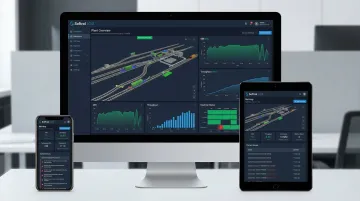
LOIS is Softrol's flagship cloud-based platform, giving operators 24/7 access to live plant performance data from any device — smartphone, tablet, or PC. Key capabilities include:
- Pan-N-Zoom technology visualizes entire rail systems to scale, with real-time I/O status at the component level
- SofTrak RFID integration tracks individual garments through their full lifecycle, including customer assignment and product history
- Real-time alerts push directly to email, keeping supervisors informed without requiring them to be on the floor
- Multi-site access from a single account, purpose-built for operators managing multiple facilities
Turnkey Integration
Softrol designs, manufactures, and installs complete systems as a single-source provider. That covers material handling (conveyors, overhead rails, automated sorting), process controls (PLCs, machine sequencing, chemical injection), and management software (LOIS, production tracking, compliance reporting).
One vendor owns the entire system. That accountability eliminates the multi-contractor blame game when integration issues arise.
24/7 Support and Service
Softrol provides round-the-clock technical support before, during, and after installation. Their team understands laundry operations intimately—they don't just troubleshoot software, they understand wash chemistry, material flow, and production scheduling. That depth of knowledge cuts resolution time when something goes wrong. The ticket-based support system creates comprehensive documentation for every service case, building a knowledge base that improves support quality over time.
Proven Track Record
Results from Softrol's customer base speak for themselves. Aramark, Crown Health Care, and Mission Linen are among operators who've documented:
- 70–77% labor reductions in sorting operations
- 30%+ throughput increases alongside 25–30% labor cost reductions
- Facilities processing 40,000+ garments daily with just 2 operators
Scalable and Future-Proof
Softrol's systems grow with your business through modular designs that support incremental expansion. Whether you're upgrading a single plant or managing multi-location operations, their solutions adapt to evolving needs. Facilities have tripled capacity from 5,000 to 15,000 garments per day over a single weekend using Softrol's expansion-ready architecture, achieving additional two-year payback periods on the expansion investment.
Conclusion
Choosing a laundry management system is a strategic decision that impacts labor costs, throughput, customer satisfaction, and competitive positioning for years to come. The right system enables growth. The wrong one creates bottlenecks that compound as your operation scales.
The goal is finding a system that aligns with your plant's specific operational priorities rather than chasing the most popular or cheapest option. A healthcare facility prioritizing HLAC compliance needs different capabilities than a uniform service focused on garment lifecycle tracking. A single-plant operator has different requirements than a multi-location enterprise needing centralized reporting.
Systems that seemed capable five years ago now routinely lack cloud access, mobile monitoring, and predictive maintenance features. Plan to revisit your technology stack periodically as your operation grows and new capabilities emerge. The goal is keeping your automation infrastructure ahead of your business — not scrambling to replace it.
Frequently Asked Questions
What factors should I consider when choosing a laundry management system?
Focus on five areas: scalability for growth, integration with your existing equipment, cloud-based real-time data access, RFID garment tracking, and vendor support quality. Also factor in total cost of ownership — most plants see ROI within 18-36 months.
What features should a laundry management system include for industrial plants?
Look for material handling automation, washer/dryer process control integration, centralized real-time dashboards, and RFID or barcode garment tracking. Remote mobile monitoring and compliance reporting tools — especially for healthcare and SLA requirements — round out a complete system.
What are the stages of the industrial laundry process that a management system should cover?
A capable system should cover the full workflow from soil sort and wash processing through drying, finishing, and clean garment sorting. Delivery and distribution — including manifest generation and route tracking — should also be included.
How can I better manage laundry operations in a high-volume plant?
Automate manual sorting and handling first — that's where the biggest labor gains are. From there, deploy mobile-accessible performance dashboards and predictive maintenance alerts. Track KPIs like pounds per operator hour, machine utilization, and cost per pound to drive continuous improvement.
How do I evaluate laundry management system vendors?
Prioritize vendors with proven industrial laundry experience — not just general automation background. Request references from similar facilities, confirm 24/7 support availability, and verify compatibility with your existing equipment. Calculate five-year total cost of ownership before committing.
What is the typical ROI timeline for a laundry management system investment?
ROI typically ranges from 18-36 months depending on plant size and system scope. Labor savings are often the biggest driver — automated departments can cut labor costs by 30-77%. Add in energy savings (up to 80% water reduction with recycling) and linen loss improvements from 15% down to under 3%, and comprehensive projects frequently hit a two-year payback.