Introduction
Industrial laundries process thousands of garments daily, and losing track of even a small percentage can mean significant revenue loss and customer dissatisfaction. Research shows that facilities without proper tracking systems experience shrinkage rates of 10–15%, while manual counting creates safety hazards and labor bottlenecks that directly impact profitability.
High-volume laundry operations depend on getting four things right:
- Accurate inventory management across every shift
- Loss prevention tied to specific customers and routes
- Customer accountability with documented delivery records
- Operational efficiency that keeps processing lines moving
The right tracking technology addresses all four directly. Facilities that have upgraded from manual counting report dramatic reductions in processing time and linen loss — but the results depend heavily on which system fits the operation.
RFID and barcode are the two dominant tracking technologies, but which one fits your operation's specific needs, budget, and workflow? The answer depends on your daily volume, processing complexity, capital availability, and growth plans.
Key Takeaways
- RFID scans hundreds of items at once, no line of sight needed — enterprise systems run $150k-$300k upfront
- Barcode costs less to start ($45k-$100k) but demands individual scans and more labor per shift
- Operations processing 5,000+ items daily typically see faster ROI with RFID due to 60-80% labor reduction
- Hybrid approaches combine both technologies across different workflow stages for maximum flexibility
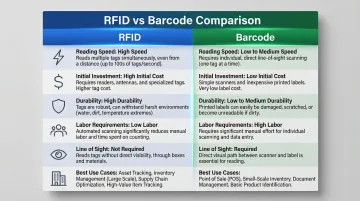
RFID vs Barcode: Quick Comparison
| Feature | RFID (UHF Washable Tags) | Barcode (Laundry-Grade Labels) |
|---|---|---|
| Reading Speed | Bulk reading: hundreds per second without line-of-sight | Manual: one item at a time with direct alignment required |
| Initial Investment | $150,000–$300,000 for enterprise implementation | $45,000–$100,000 for enterprise implementation |
| Operational Cost | $0.05–$0.15 per tag | $0.01–$0.05 per label |
| Reading Range | Up to 6–14 meters; reads through bags and carts | Inches to feet; requires visual contact |
| Line of Sight | Not required | Required for every scan |
| Durability | 200–300+ industrial wash cycles | 40–50 wash cycles before degradation |
| Data Storage | Electronic chip stores processing history | Static printed information only |
| Labor Requirements | 60–80% reduction in sorting/counting staff | High manual scanning labor at every checkpoint |
| Accuracy Rate | >99% with automated bulk scanning | High for individual items; prone to missed scans in bulk |
| Best Use Cases | High-volume uniform rental, healthcare linen, hospitality pools | Small-scale laundries, specialty processing, budget-conscious operations |
What is RFID Tracking in Industrial Laundry?
Radio Frequency Identification (RFID) uses electromagnetic fields to automatically identify and track tags attached to garments. Each tag contains electronically stored information that transmits to readers at various checkpoints throughout your facility.
How RFID Works in Laundry Operations
RFID tags are sewn into or heat-sealed onto garments, transmitting data to readers at receiving, sorting, washing, and dispatch stages — no line-of-sight required. Portal readers scan entire carts of soiled linen as they pass through dock doors, eliminating manual counting entirely.
Key benefits for laundry operations:
- Processes hundreds of items per second, cutting sorting time significantly
- Eliminates manual counting errors through automated identification
- Tracks inventory in real time across all processing stages
- Routes garments automatically to the correct wash formula and customer destination
RFID Tag Specifications
Modern washable UHF RFID tags are engineered for harsh laundry environments:
| Specification | Rating |
|---|---|
| Cycle Endurance | 200–300+ commercial wash cycles |
| Temperature Resistance | Washing at 100°C, drying at 180°C, ironing up to 210°C |
| Pressure Tolerance | Rated to 60 bar during water extraction |
| Form Factors | Flexible fabric tags (70×15mm) or silicone-encased chips for extreme durability |
Use Cases of RFID in Industrial Laundry
High-Volume Uniform Rental Services
RFID enables rapid processing of thousands of garments per route with automated billing based on actual items processed. One European industrial laundry demonstrated what that looks like in practice:
- Reduced uniform loss rates to under 3%
- Cut sorting staff from 8 people down to 1-2 operators
Healthcare Linen Tracking
Hospitals use RFID to ensure adequate par levels, prevent shortages of critical items like surgical gowns, and maintain infection control protocols. Einstein Hospital in São Paulo achieved measurable results:
- 86% reduction in inventory count time (72 hours to 10 hours)
- 80% decrease in linen loss
- $300,000 annual savings from improved inventory management
What is Barcode Tracking in Industrial Laundry?
Barcode tracking assigns a unique printed label to each garment or linen item. Scanners read each label individually at close range — which means every scan is a deliberate, confirmed verification of that specific item moving through your operation.
How Barcode Works in Laundry Context
Heat-sealed or sewn-in barcode labels are individually scanned at key process points. Operators must physically handle each garment to locate and scan the label, creating a confirmed checkpoint record for every item processed.
Core benefits for laundry operations:
- Verifies each item individually, reducing mis-sorts and misattributed losses
- Requires significantly less upfront infrastructure than RFID
- Gives operators tight, stage-by-stage control over the workflow
- Avoids customer pushback around embedded electronics in garments
Durability Considerations
Laundry-grade barcodes use specialized polyester materials and resin ribbons designed to withstand wash chemistry. However, they typically survive only 40-50 wash cycles before ink fading or label peeling requires replacement. Placing labels in low-abrasion spots — inside collar seams or hem folds — helps stretch that lifespan, but replacement costs are a recurring budget line worth factoring into your total cost comparison.
Use Cases of Barcode in Industrial Laundry
Precision-Focused Operations
Some operations need to confirm every item individually — barcode fits naturally here. The scan-per-item requirement aligns with workflows that already include hands-on visual inspection at each stage.
Barcode works well for operations that prioritize:
- Exact item-level verification with a clear audit trail
- Customer accountability where each garment must be confirmed processed
- Workflows that already require manual handling or inspection steps
Smaller-Scale or Specialty Laundry Services
Facilities processing premium garments, custom items, or lower volumes (under 5,000 items daily) find barcode cost-effective and sufficient. The lower upfront cost makes it a practical fit for operations with limited budgets or shorter-term tracking goals.
Barcode is a strong choice when:
- Volume stays under 5,000 items per day
- Garments are high-value or require individual attention
- Budget constraints make RFID infrastructure hard to justify
That cost advantage has limits, though. ROI Timeline: Barcode systems offer faster initial payback for small volumes due to low upfront cost. For facilities processing 5,000+ items daily, RFID typically delivers ROI within 18-30 months — and large-scale operations often see payback in just 9-14 months.
RFID vs Barcode: Which is Better for Your Laundry Operation?
The "better" choice depends on operation size, processing volume, budget, accuracy requirements, and growth plans—not a one-size-fits-all answer.
Volume Considerations
- Under 5,000 items/day: Barcode is typically more cost-effective due to lower upfront investment
- 5,000–10,000 items/day: RFID becomes cost-justified, with ROI in 18–30 months
- Over 10,000 items/day: RFID is the stronger choice, delivering ROI in 9–14 months
Workflow Complexity
Multi-stage operations with automated sorting benefit more from RFID's bulk reading capabilities. Operations requiring verification at each touchpoint—such as specialty dry cleaning or custom garment processing—may prefer barcode's manual verification approach.
5-Year Total Cost of Ownership Analysis
For a mid-sized facility processing 50,000 items daily, TCO analysis reveals:
| Cost Component (5-Year) | RFID System | Barcode System |
|---|---|---|
| Initial Hardware | $120,000 | $15,000 |
| Implementation | $85,000 | $25,000 |
| Tags/Labels | $2,190,000 | $365,000 |
| Labor Costs | $1,800,000 | $4,500,000 |
| Shrinkage Losses | $125,000 | $500,000 |
| Total 5-Year TCO | $4,545,000 | $5,480,000 |
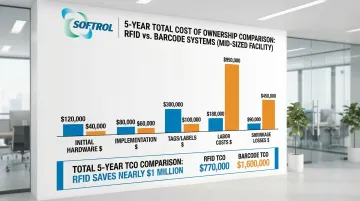
Key insight: RFID saves nearly $1 million over 5 years primarily through labor reduction and decreased linen shrinkage.
Hybrid Implementation Strategies
Many operations don't commit exclusively to one technology. A hybrid approach lets you apply each method where it performs best:
- RFID at receiving and dispatch checkpoints for high-speed bulk reads
- Barcode for customer-facing verification and high-value specialty items requiring manual inspection
- RFID in sort and storage areas where hands-free scanning improves throughput
- Barcode for audit trails on items needing individual sign-off
Integration with Plant Management Systems
Whichever tracking method you choose—or combination of both—it needs to feed data into a central management system to be useful. Without that connection, scan data stays siloed and doesn't drive decisions.
Softrol's LOIS (Laundry Operation Information System) supports both RFID and barcode inputs through the SofTrak platform, giving plant managers a single view of item counts, cycle times, and shrinkage data accessible from any device.
Real-World Implementation: RFID in Action
The Challenge
Industrial laundries face multiple operational bottlenecks: manual counting creates safety hazards at receiving docks, sorting requires excessive labor, inventory shrinkage reaches 10-15%, and billing disputes arise from inaccurate counts. These pain points directly impact profitability and customer satisfaction.
The Implementation
Softrol's SofTrak system deploys RFID technology across all critical checkpoints. Portal readers at receiving docks scan entire carts of soiled linen as they enter the facility. Fixed readers at sorting stations automatically route garments to the correct customer destinations. Dispatch readers verify delivery manifests and generate accurate billing records.
The system integrates with Softrol's broader plant automation through MicroPulse controllers and PulseNet networking—ensuring garment data follows each item from soil sorting through washing, drying, and final delivery.
Quantified Results
These results aren't theoretical. Customers running SofTrak have documented measurable gains across labor, inventory, and billing accuracy:
- Aramark Uniform Services: Processes 40,000 garments daily at 3,800/hour with a 70% reduction in sorting labor
- Mission Linen: Achieved a 77% reduction in sort labor and eliminated 18 FTE positions total
- Einstein Hospital: Cut inventory counting from 72 hours to 10 hours (86% time savings), reduced linen loss by 80%, and saved $300,000 annually
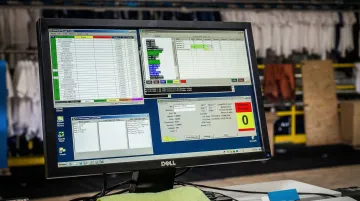
Results like these reflect what's possible when tracking integrates across the full plant—not just at one checkpoint. To discuss how SofTrak fits your operation, contact Softrol Systems at 770-974-2700.
Conclusion
There's no universal winner here. RFID suits high-volume facilities processing 5,000+ items daily, where automation and speed justify the upfront investment. Barcode remains the more practical choice for smaller or specialty operations where precision and lower cost matter most.
Before committing, weigh these factors across a 5-year horizon:
- Total cost of ownership — hardware, tags, maintenance, and labor savings combined
- System integration — compatibility with your existing MIS or wash aisle controls
- Scalability — whether the technology can grow with your throughput
- Workflow fit — where in your operation scanning actually occurs
Many facilities use both technologies together: RFID for bulk processing throughput and barcode for precision verification at manual inspection points.
The right tracking system reduces loss, improves item accountability, and gives your team data it can actually act on. Start with your current volume and where your biggest tracking gaps are — the technology choice usually follows from there.
Frequently Asked Questions
How much does RFID cost compared to barcode?
RFID tags run $0.50–$2.00 each versus $0.10–$0.30 for barcode labels, and reader infrastructure costs $150k–$300k compared to $45k–$100k for barcode systems. That said, total cost of ownership over 3–5 years often favors RFID in high-volume operations, where 60–80% labor savings and reduced shrinkage offset the upfront gap.
Which is better, RFID or barcode?
Neither is universally better. RFID suits high-volume operations processing 5,000+ items daily, where speed and automation deliver ROI in 18–30 months. Barcode works better for smaller facilities (under 5,000 items daily) or those handling specialty garments that need manual inspection and precise verification at lower upfront cost.
Is RFID outdated?
No — RFID is advancing rapidly with improved tag durability (now rated for 300+ wash cycles), longer read ranges (up to 14 meters), and stronger integration capabilities. The laundry RFID market is projected to reach $15 billion by 2033, driven by growing automation demand across textile services.
What are the 5 stages of the laundry process?
The five stages are: receiving/sorting (soiled linen intake and classification), washing (formula-based cleaning), drying (moisture removal), finishing/folding (pressing and packaging), and dispatch/delivery (customer distribution). Tracking technology impacts efficiency and accuracy at each stage, with RFID enabling automated routing and barcode providing verification checkpoints.
What is a smart laundry system?
Smart laundry systems integrate tracking technology (RFID or barcode) with plant automation, real-time analytics, and management software to optimize operations. Softrol's LOIS platform, for example, provides remote access to operational data, automated alerts, and production monitoring — giving managers the visibility to make better decisions at every processing stage.