
Introduction
Labor costs dominate the financial landscape of commercial laundry operations, typically consuming 35–55% of total operating expenses. For hotel and motel laundry facilities, this percentage climbs even higher — sorting, washing, drying, ironing, and material movement represent the single largest controllable expense category.
The pressure to cut these costs has intensified. A 2025 industry survey found that nearly 75% of laundry professionals rank "finding reliable labor" or "labor costs" as their top operational challenge. Several forces are driving this pressure:
- An aging laundry workforce with fewer younger workers entering the trade
- Stiff competition from other industries for entry-level and physical labor
- Rising federal and state minimum wages compressing already tight margins
- The physically demanding nature of traditional laundry work, which accelerates turnover
Strategic automation investments address these pressures at every stage of commercial laundry operations — from receiving and sorting through finishing and dispatch. This guide covers which automation decisions deliver the fastest ROI, how to measure long-term savings, and how facilities of all sizes can implement modular solutions that pay for themselves through labor reduction.
Key Takeaways
- Labor consumes 35-55% of operating costs, with sorting, finishing, and material handling requiring the most labor hours
- Automation multiplies productivity—automated sorting cuts labor by 70-77%, while automated folding increases output from 120 to 800+ pieces per hour
- Integrated system selection — not piecemeal upgrades — drives the largest long-term labor savings
- ROI typically ranges from 18-36 months, with sorting and folding automation delivering the fastest payback
- Modular systems let smaller plants automate incrementally, starting with sorting or finishing where labor hours are highest
How Labor Costs in Commercial Laundry Plants Typically Build Up
Labor costs in commercial laundries accumulate across multiple touchpoints throughout the processing workflow. Unlike utility costs that appear as single line items on monthly bills, labor expenses are distributed across dozens of employees at different stations. Those stations typically include:
- Receiving and weighing incoming goods
- Sorting by customer and garment type
- Loading washers and transferring loads between equipment
- Unloading dryers, folding, and finishing
- Quality inspection and dispatch preparation
The costs stay hidden because they're spread across wages at every station rather than concentrated in one budget line. A plant processing 10,000 pounds daily might employ 3-4 people in sorting, 2-3 in the wash aisle, 4-5 in finishing, and 2-3 in quality control and dispatch. No single position looks excessive—but the combined labor burden adds up fast.
Labor costs become most visible during three critical moments: periods of rapid growth when adding staff becomes necessary to increase capacity, labor shortage crises when unfilled positions create bottlenecks, and competitive benchmarking when comparing pounds per operator hour (PPOH) against industry standards reveals inefficiencies.
Key Labor Cost Drivers in Commercial Laundry Operations
Primary Labor Intensity Areas
The most significant labor costs concentrate in five core areas:
- Examining each item for customer ownership, garment type, and processing route (sorting and classification)
- Transferring heavy loads between washers, extractors, dryers, and finishing equipment
- Moving carts between receiving, washing, finishing, and dispatch stations
- Hand-folding sheets (~60 pieces/hour) and towels (~120 pieces/hour) — the single most labor-intensive operation
- Inspecting finished items for cleanliness, damage, and proper processing before dispatch
Flatwork vs. Garments: Different Labor Profiles
Not all items carry the same labor burden. Flatwork—sheets, towels, tablecloths—offers the highest automation potential because of its uniform dimensions and predictable geometry. Manual sheet folding tops out at 60 pieces per hour, while towel folding averages 120 pieces per hour.
Garments present greater complexity. Uniforms, specialty items, and customer-specific garments require more complex handling, though automated sorting systems using RFID technology have significantly cut the time spent on garment classification and routing.
Facility Layout Impact
These handling demands are compounded by layout. Inefficient floor plans increase the distance materials must travel between processing stages — a facility where sorting, washing, and finishing sit at opposite ends needs extra staff just to move goods. Every manual handoff between stations adds cost without adding output.
Cost-Reduction Strategies Through Automation
Automation strategies fall into three distinct categories, each with different implementation requirements and ROI timelines. Understanding these categories helps prioritize investments and sequence automation deployment for maximum financial impact.
Strategies That Reduce Costs by Changing Automation Decisions
Capital investment in new equipment or systems drives these strategies — and they deliver the most dramatic labor reductions:
Automated Sorting Systems
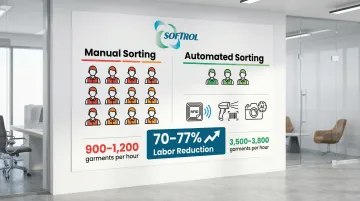
Modern sorting systems use RFID technology, barcode scanning, and image recognition to eliminate manual classification. These systems achieve 30-40% throughput increases while reducing inventory loss by 80-90%. Facilities implementing RFID-based sorting report reducing inventory count times by 86%—from 72 hours to just 10 hours—while cutting linen loss rates from 4% to 0.8%.
The labor impact is substantial. Automated sorting systems process 3,500-3,800 garments per hour with just 2-3 operators, compared to 10-13 operators required for manual sorting of equivalent volumes.
High-Capacity Tunnel Washers with Automated Loading
Replacing open-pocket washer-extractors with continuous batch tunnel systems dramatically reduces wash aisle labor density. A facility processing 1,000 pounds per hour can reduce wash aisle staffing from 3 operators to 1 operator, cutting annual labor costs by approximately $75,000. The single remaining operator manages the entire process from a central control station while automated systems handle loading, chemical injection, and transfer to drying.
Automated Material Handling Systems
Overhead rail systems, conveyors, and automated guided vehicles eliminate manual transport labor. These systems use vertical space for storage and movement, freeing floor space while reducing material handling between processing stages. Conveyor systems can eliminate up to 5.5 kilometers of daily cart pushing per employee, reducing physical strain and allowing facilities to operate with smaller crews.
Automated Folding and Finishing Equipment
Finishing automation delivers immediate, measurable productivity gains. Automated towel folders increase output from 120 pieces per hour (manual) to 800-1,000 pieces per hour, saving more than 8 labor hours per day per machine. Sheet finishing systems with automated feeders allow one operator to produce 180-300 sheets per hour compared to 60 per hour by hand, saving over 5 labor hours daily.
Strategies That Reduce Costs by Changing How Labor Is Managed
Once the right equipment is in place, how you manage labor determines whether you capture the full savings. These strategies optimize existing operations and build a foundation for continuous improvement:
Plant Management Software
Real-time productivity tracking systems identify bottlenecks, monitor operator performance, and optimize labor allocation. Facilities implementing plant management software report 12% productivity increases within four months, with management reclaiming over 30 hours weekly previously spent on manual data gathering.
The key metric is pounds per operator hour (PPOH). Instant PPOH visibility lets managers adjust staffing in real-time rather than reacting to end-of-day reports.
RFID Garment Tracking Systems
Beyond sorting, RFID systems automate inventory management and eliminate manual counting. Case studies show 86% reductions in inventory count time and approximately $30,000 in annual labor savings for linen replenishment processes alone. The technology provides real-time visibility into inventory location and status, reducing the labor required for customer inquiries and lost item investigations.
Automated Chemical Dispensing
Automated chemical injection systems eliminate manual measuring, mixing, and formula management. These systems interface directly with wash equipment, automatically delivering precise chemical quantities based on load type, eliminating the need for dedicated chemical technicians and reducing errors that lead to rewash cycles.
Automated Quality Control Systems
Vision-based inspection systems, weight verification, and moisture detection reduce manual inspection requirements. Automated rejection systems monitor residual moisture and reject items that don't meet standards, removing human error while reducing the labor hours dedicated to quality inspection.
Strategies That Reduce Costs by Changing the Operational Context
Software and equipment improvements only go so far in isolation. These strategies shape the operational environment so every automation investment performs at its ceiling:
The four core approaches here work in sequence:
| Strategy | Primary Lever | Key Outcome |
|---|---|---|
| Facility Layout Redesign | Linear workflow paths, overhead rail, mezzanine separation | Fewer labor touchpoints, reduced transport distances |
| System Integration | Unified washer-dryer-folder-conveyor workflows | One operator overseeing what previously required 3-4 |
| Incremental Automation Scaling | Bottleneck-first implementation | Two-year payback periods at each phase |
| Data-Driven Shift Optimization | Real-time PPOH data matched to demand patterns | 35% increase in pounds per operator hour within four months |
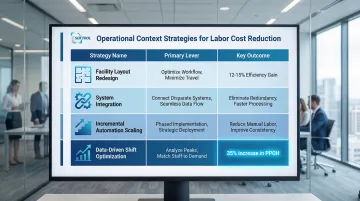
Incremental Automation Scaling deserves particular attention for plants that can't commit to full-facility automation at once. Starting with the highest-labor-intensity bottlenecks — typically sorting or finishing — ensures ROI at each stage. Labor savings from each phase fund the next investment, making full automation financially self-sustaining over a 4-6 year horizon.
Measuring Automation ROI and Long-Term Savings
Calculating Automation ROI
The fundamental ROI calculation compares current labor hours per pound processed against projected labor hours post-automation, then factors in equipment costs and installation expenses:
Payback Period = Total Investment / (Annual Labor Savings + Utility Savings)
For example, a tunnel washer system saving $74,880 annually in labor costs, plus additional water and energy savings, can achieve full payback in approximately 2 years for a $150,000 investment.
Industry Benchmarks
Key productivity benchmarks across common automation systems:
- Manual operations baseline: ~100 pounds per operator hour for wash/dry/hand-folding operations
- Automated sorting: 30-40% reduction in labor time for sorting and counting
- Automated folding: 6-8x productivity increase (from 120 to 800-1,000 towels per hour)
- Tunnel systems: 66% reduction in wash aisle labor (from 3 operators to 1)
Typical ROI Timeframes by System Type
Automation investments typically deliver these payback periods:
- Automated sorting systems: 18-24 months
- Automated folding equipment: Less than 2 years
- Tunnel washer systems: 24-36 months
- RFID tracking systems: 12-18 months
- Material handling systems: 24-36 months
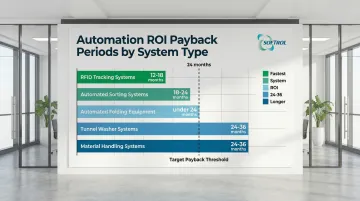
Higher-volume facilities processing more pounds daily see faster payback, as facilities amortize fixed equipment costs across greater throughput. Facilities in high-wage markets similarly achieve faster ROI due to greater labor cost savings.
Long-Term Savings Beyond Direct Labor Reduction
Payback periods tell part of the story. The financial case for automation strengthens further when you account for these ongoing savings:
- Lower training costs: Fewer positions to fill means less onboarding expense. Roles that remain are less physically demanding, which also improves retention.
- Scalable throughput: Tunnel washing, for example, can push production from 1,000 to 2,400 pounds per hour under single-operator oversight — effectively eliminating an entire 8-hour shift without adding headcount.
- Fewer workers' compensation claims: Automated material handling and sorting reduce heavy manual lifting, cutting musculoskeletal injuries and associated claim costs.
- Stronger competitive position: Lower labor cost per pound enables more competitive contract pricing or higher margins — both valuable in customer retention and new business negotiations.
Softrol Systems has supported commercial laundries in capturing these savings across sorting, material handling, wash aisle control, and plant management — with a phased approach that lets facilities prove ROI at each stage before expanding further.
Conclusion
Reducing labor costs through automation requires strategic thinking — starting with the right processes, integrating systems for efficiency, and designing workflows around automated equipment. The most successful implementations follow a clear sequence:
- Assess current labor distribution across the full plant
- Identify bottlenecks where labor hours accumulate fastest
- Select automation solutions with defined ROI timelines
Done well, automation redeploys workers rather than eliminating them. Staff move from physically demanding sorting and loading into roles like system oversight, quality control, maintenance support, and customer service — work that's less taxing, more technically engaging, and easier to staff in competitive labor markets.
With labor costs consuming up to 55% of operating expenses and shortages affecting 75% of facilities, automation is no longer a competitive advantage — it's an operational baseline. The real question is where to start and how to sequence investments for the strongest return.
Frequently Asked Questions
What is the ROI of automation in commercial laundry plants?
ROI typically ranges from 18-36 months depending on labor rates, throughput volume, and system complexity. Higher-volume plants processing more pounds see faster payback because fixed equipment costs are spread across greater output. Automated sorting and folding systems often deliver the shortest payback periods of 18-24 months.
How do you optimize laundry operations to reduce labor costs?
Start by identifying labor bottlenecks where the most hours accumulate—typically sorting, folding, and material transport. Implement targeted automation at these bottlenecks first, then use real-time data from plant management systems to steadily improve labor productivity through better shift scheduling and resource allocation.
What are the duties of laundry staff in an automated facility?
Staff roles shift from manual handling to system oversight and quality control. Operators monitor automated systems, handle exceptions, perform quality inspections, and support maintenance—positions that are less physically demanding and more technology-focused.
What types of automation deliver the fastest labor cost reduction?
Automated sorting and automated folding typically deliver the fastest ROI. Sorting automation can reduce labor by 70-77% while processing thousands of garments hourly. Automated towel folders save 8+ labor hours per day immediately upon installation, with payback periods under 2 years.
How does automation help commercial laundries handle labor shortages?
Automation reduces dependence on manual labor by cutting the operators required for core tasks. Facilities report reducing wash line staff from 3 to 1 and sorting crews from 10-13 down to 2-3—while making remaining jobs less physically demanding, which helps attract and retain workers.
Can small to mid-sized laundry plants afford automation?
Yes. Modular systems allow incremental investment starting with high-impact areas like sorting or folding. Facilities processing as little as 1,000 pounds per hour can justify tunnel washer investments, and towel folders or sorting systems typically pay for themselves in under 2 years through labor savings alone.