Introduction
Industrial laundries process tens of thousands of garments daily, and sorting is the first step that shapes everything downstream. A typical high-volume facility handles over 143,000 pounds of linen per day — accuracy and speed at the sort stage directly affect throughput, labor costs, and customer retention.
The sorting method you choose determines more than workflow. It determines profitability.
Labor accounts for 25-35% of operating expenses in commercial laundries, with mean hourly wages for laundry workers reaching $15.33 nationally in 2023. Factor in benefits, payroll taxes, and turnover, and every sorting position carries a significant ongoing cost.
Manual sorting also drives rewash rates of 3-5% — reprocessing cycles that compound labor costs further. For operations handling 10,000+ pieces daily, the gap between manual and automated sorting shows up directly on the bottom line. This article breaks down where those costs accumulate and what the numbers look like at scale.
Key Takeaways
- Manual sorting tops out at 150-250 pieces per hour per worker, with 85-92% accuracy — and mid-sized operations need 5-8 staff just to keep pace
- Automated systems process 800-3,800+ pieces per hour with 98-99.9% accuracy using RFID and barcode technology
- Hidden costs — reprocessing errors, turnover, training, and injury claims — routinely exceed what shows up on a labor budget
- High-volume operations reach ROI in 2-4 years through labor savings, fewer errors, and expanded throughput capacity
Manual vs. Automated Sorting: Quick Cost Comparison
Initial Investment
Manual: Minimal capital outlay required—basic sorting tables, bins, and simple infrastructure typically cost under $10,000 for a complete manual sorting area. This low barrier to entry makes manual sorting attractive for startups and smaller operations with limited capital.
Automated: Upfront investment ranges from $150,000 to $500,000+ depending on system complexity, throughput, and integration needs. Mid-sized operations typically invest $250,000–$400,000. Large facilities processing 40,000+ pieces daily often exceed $500,000 for comprehensive automation.
Labor Costs
Manual: High ongoing expense requiring 5–10 full-time sorters for facilities processing 10,000–15,000 pieces daily. At $15.33/hour plus 29.8% in benefits (~$19.90/hour fully loaded), a team of 7 sorters runs roughly $290,000 annually—before overtime, turnover, and training.
Automated: Reduced to 1–3 operators versus 5–10 manual sorters—a 60–80% labor reduction. For mid-sized facilities, that translates to $200,000–$400,000 in annual savings.
Sorting Accuracy
Manual: Accuracy rates of 85–92% with experienced workers, declining significantly with fatigue, distraction, or high-pressure periods. Human error increases during shift changes, peak seasons, and when processing unfamiliar garment types.
Automated: Systems achieve 98–99.5% accuracy using RFID tags and barcode scanning. Some implementations report 99.9% inventory accuracy with RFID technology, reducing misrouted garments and customer complaints to near zero.
Throughput Capacity
Manual: Limited to 150–250 pieces per hour per worker, varying by garment complexity and worker experience. A team of 7 sorters processing 200 pieces per hour each achieves maximum throughput of 1,400 pieces per hour, creating bottlenecks during peak demand.
Automated: Modern systems process 800–3,800+ pieces per hour depending on configuration. Softrol's SoftSort system handles up to 3,800 garments per hour, enabling facilities to process 40,000+ pieces daily with minimal staffing.
Operational Flexibility
Manual: Easily adapts to special handling requirements, new garment types, or seasonal variations. Workers can immediately adjust sorting criteria without programming changes, making manual sorting ideal for operations with highly variable product mixes.
Automated: Requires programming adjustments for new garment types or routing changes. Best suited for standardized, high-volume operations with consistent product categories. However, modern systems offer configurable workflows that balance automation with flexibility.
| Factor | Manual | Automated |
|---|---|---|
| Initial Investment | Under $10,000 | $150,000–$500,000+ |
| Annual Labor Cost | ~$290,000 (7 sorters) | 60–80% less |
| Sorting Accuracy | 85–92% | 98–99.5% |
| Peak Throughput | ~1,400 pieces/hr (7 workers) | 800–3,800+ pieces/hr |
| Flexibility | High — immediate adjustments | Moderate — requires reprogramming |
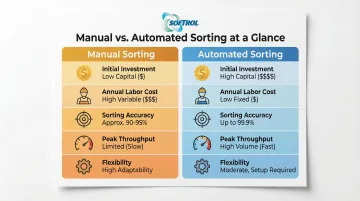
These figures give you a side-by-side baseline, but the true ROI picture depends on your facility's volume, labor market, and growth trajectory—factors the next section addresses in detail.
The True Cost of Manual Laundry Sorting
Manual sorting carries substantial hidden costs that extend far beyond hourly wages, and most operators don't see the full picture until they run the numbers.
Labor Expense Breakdown
For a mid-sized operation employing 7 full-time sorters, annual labor costs escalate fast. At the national mean wage of $15.33 per hour, base wages total approximately $222,500 annually.
Employer costs for benefits average 29.8% of total compensation — adding another $66,300 in health insurance, retirement contributions, and legally required benefits like Social Security and workers' compensation insurance.
That brings the true annual cost to $288,800 before overtime. Add peak-period premiums (typically 1.5x wages) of $30,000-$50,000, plus recruitment and training losses during ramp-up, and total sorting labor cost exceeds $350,000 per year.
Hidden Costs of Human Error
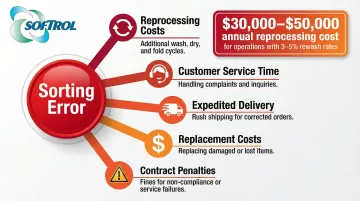
Manual sorting generates error rates that create cascading downstream costs. With typical accuracy rates of 85-92%, a facility processing 12,000 pieces daily experiences 960-1,800 misrouted garments each day. Each error triggers multiple cost components:
- Reprocessing costs: Rewashing, re-sorting, and re-routing misplaced items doubles labor, utility, and chemical expenses
- Customer service time: Investigating complaints and resolving disputes consumes management hours
- Expedited delivery: Rush shipments to correct errors add transportation costs
- Replacement costs: Lost or damaged items require inventory replacements
- Contract penalties: Repeated errors may trigger service level agreement penalties
For operations with 3-5% rewash rates, the annual cost of sorting errors typically ranges from $30,000-$50,000 in direct reprocessing expenses, with additional intangible costs from damaged customer relationships.
Productivity Limitations and Bottlenecks
Error costs are only part of the problem — sorting throughput limits how much revenue your plant can generate in the first place. Manual sorting speed creates hard ceilings on capacity. If your wash equipment can handle 15,000 pieces daily but sorting limits you to 10,000, you're leaving $200,000+ in annual revenue on the table. That gap compounds over time, preventing growth and shutting out larger contracts.
Training and Turnover Costs
The laundry industry sees significant workforce churn. Total separations reached 3.2% monthly in December 2025 — roughly 38% annually. For a 7-person sorting team, that means replacing 2-3 workers every year. Each hire carries costs that add up quickly:
- Recruitment fees and job posting costs
- Paid training time before new hires reach full productivity
- Reduced output during the learning curve, often lasting 2-4 weeks
- Total per-hire cost: $3,000-$5,000, recurring every time someone walks out
Workplace Safety and Workers' Compensation
Manual sorting involves repetitive motions, heavy lifting, and handling of soiled textiles, creating significant injury risk. Industrial launderers recorded a Total Recordable Incident Rate (TRIR) of 2.9 per 100 full-time employees in 2024, with musculoskeletal disorders accounting for the majority of claims. Each workers' compensation claim costs thousands in medical expenses, lost-time wages, and increased insurance premiums.
The True Cost of Automated Garment Sorting
Automated systems require substantial upfront investment but deliver compelling long-term value through labor savings, accuracy improvements, and operational efficiency gains.
Capital Investment and Financing Considerations
Automated sorting system costs vary by operation size and complexity:
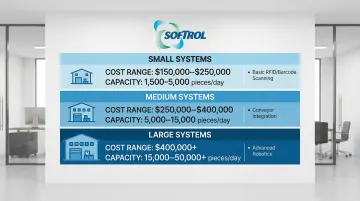
- Small systems ($150,000-$250,000): Handle 1,500-5,000 pieces daily with basic RFID or barcode scanning
- Medium systems ($250,000-$400,000): Process 5,000-15,000 pieces daily with integrated conveyor systems and buffering
- Large systems ($400,000+): Support 15,000-50,000+ pieces daily with advanced robotics, multi-level rail systems, and comprehensive integration
Equipment financing options typically include capital leases, operating leases, and equipment loans with terms of 5-7 years. Monthly payments for a $300,000 system financed at 6% over 5 years would be approximately $5,800, totaling $69,600 annually.
Technology Requirements and Integration Costs
Supporting infrastructure adds to the total investment. RFID tag readers, barcode scanners, conveyor systems, and distributed control systems with touchscreen interfaces typically add 15-25% to base equipment costs. Software integration with existing laundry management systems requires additional investment — platforms like Softrol's LOIS connect directly to plant operations, giving managers real-time production data and performance metrics from any location.
Physical installation adds another layer of cost. Integration expenses include electrical work, structural modifications, and facility upgrades to accommodate overhead rail systems. For facilities with adequate ceiling height, overhead storage designs free up floor space while improving workflow.
Ongoing Maintenance and Technical Support
Annual maintenance costs typically run 3-5% of system cost — approximately $9,000-$15,000 annually for a $300,000 system. This covers preventive maintenance, software updates, and parts replacement. Quality systems include 24/7 technical support to minimize downtime, with monitoring tools that flag maintenance needs before failures occur.
Softrol's LOIS platform includes PM Tracker technology that automates preventive maintenance scheduling, tracks parts costs and labor hours, and identifies problem equipment before breakdowns impact production.
Reduced Labor Costs and Reallocation Opportunities
With maintenance costs predictable and bounded, the primary ROI driver is labor reduction. Cutting from 7 manual sorters to 2 system operators saves approximately $240,000 annually in direct labor costs. That's not the end of the savings, either. Redeployed workers shift to higher-value tasks — quality control, finishing, customer-facing roles — compounding the initial gains.
Real-world results demonstrate the magnitude of savings. Aramark Uniform Services reduced sorting workforce by 70% (from 10 employees to 2), while Mission Linen achieved 77% labor reduction plus eliminated 8 additional FTEs through improved scheduling flexibility.
Operational Efficiency Gains
Automated systems deliver value beyond labor savings. Systems can process up to 2,200 pieces per hour using RFID and vision technology, compared to manual rates of approximately 120 pieces per hour for tasks like towel folding. This 18x throughput increase enables facilities to handle growing volumes without proportional staffing increases.
Accuracy improvements from 88% (manual) to 99%+ (automated) reduce rewash rates, cutting utility and chemical costs while improving customer satisfaction. Real-time tracking also shortens dispute resolution cycles — when a customer questions a missing garment, the system produces a timestamped audit trail rather than a manual search.
Manual vs. Automated: Which Delivers Better ROI?
ROI from automated sorting isn't universal — it hinges on your daily volume, local labor costs, and growth trajectory. Understanding where your operation falls on those dimensions points clearly toward one approach or the other.
ROI Calculation Framework
Calculate payback period using this formula:
Payback Period (Years) = Initial Investment ÷ (Annual Labor Savings + Error Reduction Savings + Throughput Value Increase)
For a $385,000 automated system delivering $240,000 in annual labor savings, $35,000 in error reduction savings, and $180,000 in additional revenue from increased capacity, the calculation is:
$385,000 ÷ ($240,000 + $35,000 + $180,000) = 0.85 years (approximately 10 months)
Most high-volume operations achieve payback in 2-4 years, with some installations reaching ROI in under 18 months when accounting for all benefit categories.
Volume Thresholds That Favor Automation
Those payback timelines depend heavily on scale. The table below shows where the ROI math typically shifts:
| Daily Volume | Recommended Approach | Notes |
|---|---|---|
| Under 5,000 pieces | Manual sorting | Cost-effective unless labor shortages or high error rates are a factor |
| 5,000–10,000 pieces | Evaluate case-by-case | Labor market wages, error rates, and growth plans drive the decision |
| 10,000+ pieces | Automation | Labor savings alone typically justify investment within 2-3 years |
In high-wage markets like California ($18.17/hour) or Washington ($18.32/hour), that breakeven point shifts downward — automation pencils out at lower volumes than in regions with lower prevailing wages.
Situational Recommendations
Choose manual sorting if you have:
- Daily volumes under 5,000 pieces
- Highly variable garment types requiring frequent handling adjustments
- Limited capital for upfront investment
- Seasonal fluctuations with significant volume swings
- Adequate labor supply at reasonable wages
Choose automated sorting if you have:
- Consistent volumes exceeding 10,000 pieces daily
- Standardized garment types with RFID or barcode tagging
- Labor recruitment or retention challenges
- Growth plans requiring scalable capacity
- Space constraints where vertical storage adds value
Real-World Cost Analysis: Making the Switch to Automation
Consider a mid-sized uniform rental operation processing 12,000 pieces daily with 7 manual sorters earning $16/hour. An 8% error rate and a sorting bottleneck cap throughput well below what the wash aisle can actually handle.
Current State Costs
Annual manual sorting labor: 7 sorters × $16/hour × 2,080 hours × 1.298 (benefits) = $301,000
Error-related costs: 12,000 pieces/day × 8% error rate × 250 working days × $1.50 reprocessing cost per item = $36,000
Opportunity cost: Wash capacity could handle 15,000 pieces daily, but sorting limits throughput to 12,000. The 3,000-piece daily gap represents $750,000 in foregone annual revenue at $1.00 net margin per piece.
Total annual cost of manual sorting: $1,087,000 (direct costs + opportunity costs)
Automation Investment
$385,000 for an automated sorting system with RFID technology, including installation, operator training, and first-year maintenance. The system integrates with existing plant management software and includes 24/7 technical support.
Results and ROI
Within 18 months:
- Labor costs reduced by $210,000 annually: Eliminated 5 positions, retained 2 operators at slightly higher wages
- Error rates dropped to under 2%: Saving $27,000 annually in reprocessing costs
- Throughput increased 25%: Enabled 15,000 pieces daily, generating $750,000 in additional annual revenue at $1.00 net margin
Total annual benefit: $987,000
Payback period: $385,000 ÷ $987,000 = 0.39 years (approximately 5 months)
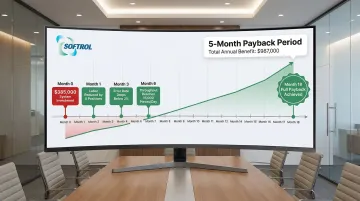
A five-month payback is possible because the gains stack — lower labor costs, fewer reprocessing runs, and capacity that was already sitting idle all contribute simultaneously.
Softrol's SoftSort systems with SofTrak RFID technology are built to deliver exactly this type of outcome. Processing up to 3,800 garments per hour and reducing sorting labor by 70–77%, SoftSort integrates directly with existing plant management software — giving uniform rental operations, healthcare laundries, and hospitality textile services a clear path from current costs to measurable savings.
Ready to analyze the ROI potential for your operation? Contact Softrol Systems at 770-974-2700 to discuss your automated sorting options and receive a customized cost-benefit analysis tailored to your facility's volume, constraints, and growth objectives.
Conclusion
The true cost of laundry sorting extends far beyond equipment price tags. It encompasses labor expenses, error reprocessing, throughput constraints, safety risks, and growth limitations. For high-volume operations, automated sorting typically delivers compelling ROI through combined labor savings, accuracy improvements, and capacity expansion that manual processes simply cannot match.
The right choice depends on your operation's specific circumstances. Use these benchmarks to guide the decision:
- Smaller facilities with variable volumes and stable labor supply may find manual sorting still viable
- Growing operations should evaluate automation once volume scaling strains throughput or labor costs begin climbing
- High-volume facilities with expansion goals will typically see the strongest ROI case for automated garment sorting
Start with a full cost analysis — direct and hidden — then pressure-test your projections against real numbers from similar operations before committing either way.
Frequently Asked Questions
What is the typical ROI timeline for automated garment sorting systems?
High-volume operations processing 10,000+ pieces daily typically achieve ROI in 2-4 years through combined labor savings, error reduction, and increased throughput. Some facilities reach payback in under 18 months when capacity expansion and redeployed labor benefits are factored in.
How much labor cost can automation save in a commercial laundry operation?
Automation typically reduces sorting labor by 60-80%, with operations commonly eliminating 5-7 manual sorting positions while retaining 1-2 system operators. This translates to $200,000-$400,000 in annual labor savings for mid-sized facilities processing 10,000-15,000 pieces daily.
What are the hidden costs of manual sorting errors?
Hidden costs include reprocessing expenses (labor, utilities, chemicals), customer service time investigating complaints, replacement costs for damaged items, expedited delivery charges, and potential contract penalties. Each 1% improvement in accuracy can save $5,000-$10,000 annually in direct reprocessing costs alone.
Can automated sorting systems handle all garment types?
Automated systems handle most standardized commercial garments — uniforms, healthcare linens, and hospitality textiles — provided they can be tagged with RFID or barcodes and transported on standard hangers. Highly specialized, delicate, or non-hanging items may still require manual handling or hybrid approaches.
What is the upfront investment for automated garment sorting?
Typical investment ranges by operation size:
- Smaller systems (1,500-5,000 pieces/day): $150,000-$250,000
- Mid-sized operations (5,000-15,000 pieces/day): $250,000-$400,000
- Large-scale facilities (15,000-50,000+ pieces/day): $400,000+
Final costs depend on throughput requirements, technology features, integration complexity, and facility constraints.
How does sorting accuracy impact overall laundry operation costs?
Each 1% accuracy improvement saves thousands annually by reducing reprocessing, complaints, and expedited delivery costs. The gap between 88% manual accuracy and 99% automated accuracy typically represents $30,000-$50,000 in annual savings for mid-sized operations — plus gains in customer retention and contract compliance.