This scenario plays out in commercial laundries more often than most operators realize. Chemical dosing accuracy is one of the most overlooked factors affecting both quality and profitability in commercial laundry operations. Yet chemicals represent 17-48% of annual operating costs for most facilities, often exceeding $125,000 annually.
The impact is two-fold: wash quality issues create rewash cycles, customer complaints, and accelerated linen damage, while operational cost increases stem from chemical waste, excess energy consumption, and equipment maintenance problems. Even small dosing variations of 5-10% compound over thousands of wash cycles into significant financial losses.
TLDR: Key Takeaways
- Dosing errors raise operating costs 15–30% — through chemical waste, rewash cycles, and accelerated equipment wear
- Under-dosing creates poor cleaning results; over-dosing wastes money and damages linens
- Automated flow-meter systems achieve 95%+ accuracy versus 60-75% for manual methods
- Monthly calibration and water quality monitoring are essential for healthcare facilities
- Systems combining chemical dispensing controls with LOIS integration track usage data and surface cost reduction opportunities in real time
What is Chemical Dosing and Why Accuracy Matters
Chemical dosing is the process of adding precise amounts of detergents, alkalis, bleaches, fabric softeners, and other chemicals at specific points in the wash cycle. In commercial operations, this might involve up to 100 different chemical formulations tailored to specific soil types and fabric classifications.
Dosing accuracy measures the difference between the target dose and the actual dose delivered, typically expressed as a percentage. Automated dosing systems aim for tolerances of ±3% to ±6%, while manual or poorly maintained systems may vary by 10-30%.
Those percentage gaps look minor on paper, but at industrial scale the financial consequences stack up fast:
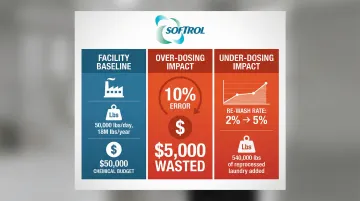
- A facility processing 50,000 pounds daily runs approximately 18 million pounds annually
- A 10% over-dosing error on a $50,000 chemical budget wastes $5,000 directly
- Under-dosing that increases rewash rates from 2% to 5% means an additional 540,000 pounds must be reprocessed
- Each rewash doubles the labor, water, energy, and machine time for those loads
How Chemical Dosing Accuracy Directly Impacts Wash Quality
The Chemistry of Clean
Effective cleaning requires specific chemical concentrations at precise temperatures and pH levels. Commercial laundering depends on four interacting factors — time, temperature, mechanical action, and chemistry — and dosing errors throw all four out of balance.
Hot water washing typically requires 160°F (71°C) for a minimum of 25 minutes to ensure microorganism destruction. Chlorine bleach activates optimally between 135°F and 145°F. The wash process involves high alkalinity (pH around 12) for soil removal, followed by a sour rinse that shifts pH down to 5 to neutralize alkalinity and inactivate remaining microorganisms.
Consequences of Under-Dosing
Insufficient chemical concentration compromises every aspect of cleaning:
- Stains remain visible and fabrics appear dingy or gray
- Sanitizer concentrations fall below ASTM E2274 standards required for healthcare linens
- Rewash rates climb above the industry benchmark of 3–5%, driving up labor and utility costs
- Healthcare facilities face real consequences — mold outbreaks on bed sheets have been traced to sanitization failures
For healthcare laundries, under-dosing isn't just a quality issue—it's a safety risk. HLAC accreditation mandates monthly calibration of chemical delivery systems to ensure precise concentrations meet required microbial reduction targets.
Consequences of Over-Dosing
Excessive chemical usage is equally destructive:
- Bleach over-dosing weakens fibers, cutting textile life well short of its expected cycle count
- Excess chemicals leave residues that cause skin irritation and fabric stiffness
- Mineral salts and chemical buildup create a dingy, grayed appearance over time
- Corrosive concentrations damage hoses, motors, and inverters — turning a dosing error into an equipment repair bill
Premature linen replacement accounts for 15–25% of total operating costs. That cost climbs fast when over-dosing is the norm rather than the exception — which is why matching chemical concentration to the specific linen type matters as much as the dosing accuracy itself.
Dosing Requirements by Linen Type
Different textiles require specific chemical formulas:
- Terry towels need more aggressive alkali to cut through oil and body soil
- Healthcare linens require validated sanitizer concentrations for infection control compliance
- Uniforms call for specialized stain treatments targeting food, grease, and industrial soils
- Sheets perform best with balanced formulas that maintain brightness without excessive bleach exposure
Automated dosing systems adjust dosing based on actual load weight. If a washer is loaded to only 50% capacity, smart dosing systems can reduce water and chemical usage by up to 30%, maintaining proper concentration ratios.
The Financial Impact: How Dosing Accuracy Affects Operating Costs
Direct Chemical Waste
Consider a facility with $50,000 in annual chemical spend:
- 10% over-dosing = $5,000 wasted annually
- 20% over-dosing = $10,000 wasted annually
- 30% over-dosing (common with manual systems) = $15,000 wasted annually
For larger operations spending $125,000+ annually on chemicals, a 10% dosing error translates to $12,500 in direct waste, enough to fund the system upgrades that would eliminate it.
Rewash Cycle Costs
Industry benchmarks place rewash rates at 3-5%, with leading operations targeting below 3%. When rewash rates exceed this threshold, costs multiply rapidly:
Example calculation for a 50,000 lb/day facility:
- Daily production: 50,000 lbs
- Target rewash rate: 2%
- Actual rewash rate due to dosing issues: 5%
- Excess rewash: 1,500 lbs/day or 547,500 lbs/year
Each rewashed pound consumes additional labor, water (typically 2-3 gallons per pound), energy for heating, and machine time.
When items require rewashing, utility and labor costs effectively double for those items.
Hidden Costs: Premature Linen Replacement
Linen replacement typically represents 15-25% of total operating costs. Chemical damage from inconsistent dosing—particularly over-dosing with bleach and alkalis—accelerates fabric degradation, forcing premature replacement.
Improving wash chemistry through accurate dosing can yield savings of up to 20% in textile replacement costs. For a facility spending $50,000 annually on linen replacement, that's $10,000 back per year.
Equipment Maintenance Costs
Poor chemical management creates additional maintenance burdens:
- Hard water combined with improper dosing causes limescale buildup and boiler breakdowns
- Undiluted or excessive chemicals corrode expensive washer components
- Chemical residue clogs delivery lines and damages dosing pumps
The Multiplier Effect
Inaccurate dosing in one area cascades into other problems:
- Insufficient detergent requires more bleach to compensate for poor soil removal
- Excess bleach demands additional rinse cycles to remove residue
- Extra rinses increase water, energy, and time costs
- Extended cycle times reduce daily throughput capacity
ROI from Improved Dosing Accuracy
The numbers from actual installations are hard to ignore. One distributor implementing advanced dosing systems reduced chemical dispensing labor and equipment maintenance costs by approximately 80%. Another operation switching from manual to automated dosing eliminated spillage, cut consumption, and increased daily wash capacity.
Conservative ROI calculation:
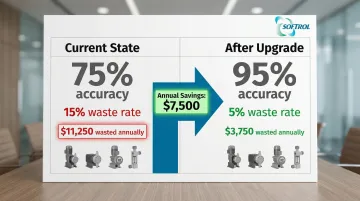
- Current accuracy: 75% (typical for basic pump systems)
- Target accuracy: 95% (flow-meter systems)
- Annual chemical spend: $75,000
- Current waste from over-dosing: 15% = $11,250
- Reduced waste at 95% accuracy: 5% = $3,750
- Annual savings: $7,500 in chemical costs alone
That's before accounting for rewash reductions, extended linen life, and lower maintenance costs. For most mid-sized operations, total annual savings land between $15,000 and $25,000 — and the payback period on upgraded dosing systems is typically well under two years.
Types of Chemical Dosing Systems and Their Accuracy Levels
Manual Dosing Methods
Hand-dosing practices involve operators manually measuring and adding chemicals to wash loads. This method typically achieves 60-75% accuracy at best.
Human error factors include:
- Measurement inconsistencies between shifts and operators
- Formula variations due to misreading instructions
- Spillage during chemical handling
- Training challenges with staff turnover
- Fatigue-related mistakes during high-volume periods
Manual dosing also creates safety risks from chemical exposure and generates significant labor costs—both of which automation directly addresses.
Basic Automated Systems: Peristaltic Pumps
Peristaltic pump systems use rollers to squeeze chemicals through flexible tubes, achieving 75-85% accuracy when properly maintained.
Key limitations:
- Tubes lose elasticity and require replacement every 1-6 months
- A pump calibrated for 15ml/kg can degrade to delivering only 3ml/kg as tubes wear
- Supply pressure changes affect delivery volumes, introducing inconsistency
- Recurring tube replacement adds both parts cost and technician labor
Despite these drawbacks, peristaltic systems meaningfully outperform manual dosing. For operations with higher volume or stricter quality requirements, though, the accuracy drift becomes a real liability—which is where advanced systems come in.
Advanced Automated Systems
Flow-meter and gravimetric systems deliver measurably better performance, achieving 95%+ accuracy with built-in delivery verification.
Flow-meter systems like Softrol's Catalyst product line measure actual chemical delivery volumes through precision flow meters. These systems verify that the intended chemical quantity was actually dispensed, providing ±3% accuracy when properly calibrated.
Key advantages:
- No squeeze tubes to replace—lower maintenance
- Consistent accuracy over time without drift
- Volumetric verification of actual delivery
- Real-time feedback and delivery failure alarms
- Water flush verification prevents cross-contamination
Gravimetric systems measure chemicals by weight rather than volume. This approach provides "Truth in Delivery" verification that accounts for viscosity and temperature variations—factors that can skew volume-based measurements significantly. For operations handling a wide range of chemical formulations, this makes gravimetric systems particularly reliable.
Integration with Management Systems
Advanced systems like Softrol's Catalyst chemical dispensers integrate with LOIS (Laundry Operation Information System) software to provide chemical usage tracking and reporting across the entire operation. This gives plant managers:
- Automatic chemical usage tracking by load, formula, and time period
- Real-time alerts for delivery failures
- Efficiency reports identifying optimization opportunities
- Multi-site access to chemical consumption data
- Automated documentation for regulatory compliance
Comparison of Dosing Methods
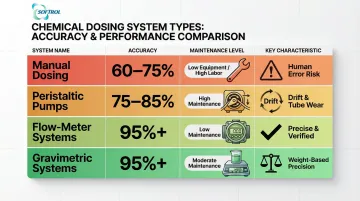
| System Type | Accuracy Level | Maintenance | Key Characteristics |
|---|---|---|---|
| Manual Dosing | 60-75% | Low equipment / High labor | Human error, spillage, inconsistency |
| Peristaltic Pumps | 75-85% | High (tubes every 1-6 months) | Accuracy drifts as tubes wear |
| Flow-Meter Systems | 95%+ (±3%) | Low | No tubes, consistent accuracy, verification |
| Gravimetric Systems | 95%+ | Moderate | Weight-based, compensates for viscosity |
Best Practices for Maintaining Chemical Dosing Accuracy
Calibration Schedules
Skipping calibration doesn't just risk non-compliance — it lets dosing drift quietly until quality problems surface. Calibration requirements vary by facility type:
Healthcare facilities: HLAC accreditation requires monthly calibration of chemical delivery systems
Standard commercial operations:
- Flow-meter systems: Quarterly calibration
- Peristaltic pump systems: Monthly verification
- High-volume operations: Monthly calibration regardless of system type
Calibration process involves:
- Measuring actual chemical delivery against programmed amounts
- Adjusting pump speeds or flow meter settings
- Documenting results and maintaining records for compliance
- Testing delivery at multiple dosing levels (low, medium, high)
TRSA standards mandate that calibration records be maintained for six years to demonstrate ongoing compliance.
Water Quality Monitoring
Water quality directly affects how well chemicals perform — and how much of them you actually need:
Critical parameters:
- Water hardness — Above 2 grains/gallon (34.2 ppm), softening or formula adjustments are required
- Inlet temperature — Variable water temperature produces inconsistent chemical reaction rates across loads
- Baseline pH — Incoming water pH determines how much alkalinity your formula actually needs
Consequences of ignoring water quality:
- Hard water neutralizes detergents, requiring higher doses for the same result
- Mineral content causes "graying" from soil and salt redeposition
- Inconsistent water temperature creates variable chemical reaction rates
Facilities should conduct regular water quality testing and adjust chemical formulas seasonally as municipal water sources change.
Documentation and Tracking
Without documentation, dosing problems are only visible after wash quality degrades. Tracking the right data points allows problems to be caught early:
Required documentation:
- Monthly titrations of wash chemistry to verify formulas
- pH spot tests on final rinse water (target: 5-6)
- Residual chlorine tests on finished goods
- Chemical usage logs correlated with production volumes
- Rewash rate tracking by formula and linen type
Modern systems like Softrol's LOIS automate this tracking, capturing chemical usage data automatically and generating reports that correlate dosing with quality outcomes. That removes the manual logging burden and gives managers dosing trend data they can act on before small deviations become costly rewash cycles.
Common Chemical Dosing Problems and Solutions
Symptoms of Dosing Inaccuracy
Watch for these indicators of dosing failure:
Quality indicators:
- Rewash rates consistently above 3-5%
- Variable whiteness or stain removal between loads
- Customer complaints about linen appearance or texture
- Premature fabric tearing or thinning
Operational indicators:
- Chemical usage not matching expected levels based on load counts
- Low chemical alerts occurring more frequently than expected
- Excessive chemical inventory consumption
- Equipment corrosion or chemical buildup in machines
Testing indicators:
- Final rinse pH outside 5-6 range
- Positive residual chlorine tests on finished goods
- Visible chemical residue or stiff fabric hand-feel
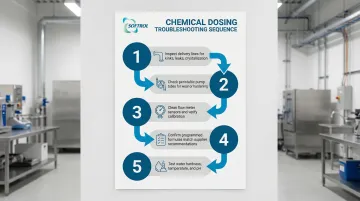
Troubleshooting Steps
When dosing problems appear:
- Check delivery lines for kinks, leaks, or chemical crystallization
- For peristaltic systems, inspect pump tubes for wear or hardening
- Clean flow meter sensors and verify calibration against known volumes
- Confirm programmed formulas match your chemical supplier's current recommendations
- Test water hardness, temperature, and pH to rule out water quality as a variable
When to Upgrade Systems
If troubleshooting reveals recurring failures rather than isolated issues, the problem is likely the system itself — not a single component. Calculate the break-even point before committing to repairs on aging equipment:
Upgrade decision factors:
- Current annual chemical waste exceeds $5,000
- Rewash rates consistently above 3%
- Maintenance costs for existing systems exceed $3,000 annually
- Facility lacks automated documentation for compliance
- Manual dosing creates safety concerns or labor inefficiency
Operations that hit two or more of these thresholds typically see ROI on flow-meter upgrades within 12-24 months — driven by lower chemical spend, fewer rewashes, and reduced maintenance overhead.
Frequently Asked Questions
What is a chemical control system?
A chemical control system integrates with washing machine controls to deliver precise chemical amounts at programmed intervals throughout the wash cycle. It eliminates manual measurement and ensures consistent formula execution across every load.
How many washes to get chemicals out of clothes?
Properly dosed chemicals should rinse out completely in standard rinse cycles (typically 2-3 rinses). Over-dosed chemicals may require additional rinses. Check for residue by verifying final rinse pH falls between 5-6 and running residual chlorine spot tests on finished goods.
What is the ideal chemical dosing accuracy for commercial laundry?
Industry best practice targets 95%+ accuracy (±3% to ±6% tolerance). This precision level balances cost-effectiveness with optimal wash results, minimizing waste while ensuring consistent quality and sanitization.
How much can poor chemical dosing increase operating costs?
Poor dosing typically increases operating costs by 15-30% through direct chemical waste, rewash cycles that double processing costs for affected loads, and accelerated linen replacement from chemical damage.
What are the signs of inaccurate chemical dosing in my laundry?
Observable indicators include inconsistent wash quality between loads, chemical usage not matching expected levels, rewash rates above 3%, equipment corrosion, final rinse pH outside 5-6 range, and customer complaints about linen appearance or texture.
How often should chemical dosing systems be calibrated?
Most commercial operations should calibrate peristaltic pump systems monthly and flow-meter systems quarterly. Healthcare facilities follow monthly calibration per HLAC standards, with documentation retained for six years per TRSA requirements.