Introduction
Industrial laundry operations face mounting financial pressure from rising utility costs. Municipal water rates are increasing by approximately 4% annually, while water heating alone consumes roughly 90% of the energy required to run a clothes washer. For high-volume facilities processing over 500 pounds daily, these escalating costs translate directly to eroded profit margins.
Those utility costs are only part of the picture. Inefficient water management compounds expenses across three fronts:
- Direct water consumption charges from rising municipal rates
- Wastewater disposal fees that often exceed the cost of potable water
- Energy costs for heating water that could be reduced or recovered
Facilities also face sustainability certification barriers and tightening regulatory compliance standards. Operations running outdated equipment waste 30-50% of their water—a gap that modern conservation strategies can close with measurable cost savings.
Key Takeaways
- Inefficient equipment and outdated processes waste 30-50% of water in typical industrial laundries
- Effective reductions combine equipment upgrades, smarter wash programming, and real-time monitoring
- Modern technologies including advanced recycling systems and smart controls deliver 40-85% water reduction
- ROI on conservation investments typically ranges 1-3 years based on facility size and current efficiency baseline
- Start with a baseline water audit — it pinpoints the highest-impact changes before any capital is committed
How Water Costs Build Up in Industrial Laundry Plants
Water costs in industrial laundries accumulate across multiple dimensions that many operators underestimate. Direct water consumption represents only the starting point—wastewater treatment and disposal often costs more than the incoming potable water itself. In documented case studies, sewer rates exceeded water rates by more than double ($15.57 per thousand gallons versus $7.42 per thousand gallons), making wastewater reduction a critical financial lever.
Beyond the water bill itself, three additional cost layers drive the total higher:
- Energy: Water heating accounts for roughly 90% of laundry energy consumption. Facilities that default to hot water for all loads pay for that habit every cycle.
- Chemicals: Water volume and chemical dosing are directly linked. More water means more detergent—and improper dosing triggers extra rinse cycles to clear the surplus.
- Wastewater surcharges: High-volume discharge often carries tiered municipal surcharges, meaning the cost per gallon rises as consumption climbs.
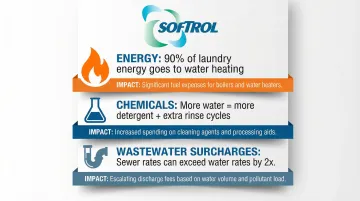
Taken together, these costs compound as equipment ages and efficiency degrades. What seemed manageable five years ago becomes a real budget pressure today as water rates climb and machinery performance deteriorates.
Many of these costs stay hidden until someone measures them. Inefficient rinse cycles waste both water and chemicals without obvious operational signals. Facilities without submetering have no way to identify which equipment, shifts, or processes are driving excess consumption.
Key Water Consumption Drivers in Industrial Laundry Operations
Equipment Type and Age
Equipment fundamentals determine baseline water consumption more than any other factor. Top-load washers use 2-4 gallons per pound of laundry, while modern tunnel washers operate at 2 gallons per pound or less—a difference of 30-60% in water consumption. Machines over 10 years old typically lack modern efficiency features including load-sensing technology, optimized rinse cycles, and water recycling capabilities.
Water use varies significantly by machine type:
- Standard washer-extractors: 2.0-4.0 gallons per pound
- High-efficiency tunnel washers: ≤2.0 gallons per pound
- Advanced continuous batch washers: 0.3-0.66 gallons per pound for light to medium soil
Operational Practices Drive Variability
Even with efficient equipment, operational practices create significant variability in water consumption. Several common habits quietly inflate water use:
- Underloading: Running full-capacity cycles for partial loads wastes water on every batch
- Overloading: Forces rewash cycles that effectively double consumption
- Excess rinse cycles: Unnecessary cycles add 15-25% to total water use without improving results
- Poor soil sorting: Mixing lightly and heavily soiled items forces the entire load through intensive cycles
Proper soil-based sorting alone can cut cycle counts substantially. Lightly soiled hotel linens typically need just 3 cycles (wash/bleach/rinse), while heavily soiled industrial uniforms may require 7 or more.
Facility Type Influences Consumption Patterns
Different facility types face distinct water consumption challenges:
- Healthcare laundries require intensive wash cycles for sanitization, typically using more water per pound due to stringent infection control standards and higher temperature requirements
- Hospitality laundries process high volumes of lightly soiled linens, making them ideal candidates for water recycling systems that can reclaim 80%+ of water
- Uniform services handle varied soil levels from light office wear to heavy industrial contamination, requiring flexible wash programming
Lack of Monitoring Prevents Optimization
Without submetering or real-time tracking, operators cannot pinpoint which processes, shifts, or equipment drive excess consumption. Facilities without this data operate without the visibility needed to establish baselines, identify waste patterns, detect leaks, or measure the impact of conservation investments.
Water Conservation Strategies for Industrial Laundry Plants in 2026
Effective water conservation requires a multi-layered approach: upgrading equipment where it delivers ROI, optimizing operational practices that cost little to implement, and deploying monitoring technology that enables continuous improvement. The following strategies represent 2026's most effective interventions.
Equipment-Based Water Conservation Strategies
Replace Aging Top-Load Washers
High-efficiency front-load models or washer-extractors use 50-70% less water per pound of laundry and extract more moisture to reduce drying energy. ENERGY STAR certified commercial washers use 45% less water than standard models, with the added benefit of qualifying for utility rebates that reduce upfront costs by 15-30%.
Install Tunnel Washers for High-Volume Operations
Facilities processing 2,000+ pounds per hour should evaluate tunnel washers that enable counter-flow water recycling. Final rinse water from one batch becomes wash water for the next, reducing consumption by 30-60% compared to standard washer-extractors. Advanced continuous batch systems achieve 0.3-0.66 gallons per pound for light to medium soil loads.
Add Water Recycling and Reclamation Systems
Water recycling offers the highest reduction potential:
- Simple systems capture and reuse final rinse water for the next load's pre-wash, saving 10-35% with minimal treatment requirements
- Advanced systems with microfiltration can reclaim 80-85% of water by treating both wash and rinse water for reuse in all stages
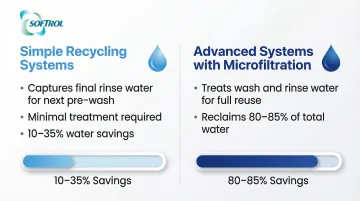
One documented hotel installation achieved 80% water reduction with a simple payback period of less than one year due to high utility rates and significant processing volume.
Consider Ozone Laundry Systems
Ozone systems reduce water temperature requirements from 140°F to 80°F, shorten wash cycles, and decrease rinse requirements by reducing chemical usage. These systems typically deliver 10-25% water savings, with the primary benefit being a 63% reduction in hot water consumption. Best suited for lightly soiled loads in hospitality applications.
Specify Load-Sensing Technology
Equipment with integrated load-sensing automatically adjusts water levels based on actual load weight, preventing the common waste of using full-capacity water for partial loads. This technology is standard in modern high-efficiency washers but absent in most equipment over 10 years old.
Operational Management Strategies
Establish Load Optimization Protocols
Train staff to fill washers to 80-85% capacity using visual guides or scales. Implement policies preventing undersized loads during low-volume periods. Running machines at partial capacity without adjustable water levels destroys efficiency metrics (gallons per pound).
Set Up Soil-Based Sorting and Cycle Programming
Separate laundry by soil level (light/medium/heavy) and program appropriate wash cycles:
- Lightly soiled hotel linens: 3 cycles (wash/bleach/rinse)
- Medium soil uniforms: 4-5 cycles
- Heavily soiled industrial items: 7+ cycles
This sorting discipline prevents over-processing lightly soiled items and reduces total facility water consumption by 15-25%.
Optimize Water Temperature Usage
Reserve hot water cycles only for heavily soiled items or sanitization requirements. Shift lightly soiled loads to cold water washing with modern detergents formulated for lower temperatures. This reduces both water heating energy and total water consumption, as cold water cycles often require fewer rinse cycles.
Regulate Water Pressure
Install pressure regulators at equipment supply lines to maintain 30-50 PSI. Optimal performance occurs between 30-85 PSI, while excessive pressure forces more water through fill valves than needed and can increase consumption by 5-10% without improving cleaning effectiveness.
Technology and Automation Strategies
Deploy Real-Time Water Monitoring Systems
Install submetering at equipment or process level to establish baseline consumption, identify anomalies, detect leaks, and track efficiency improvements over time. The EPA explicitly recommends facilities "install and frequently monitor water submeters" to establish baselines and validate savings.
Integrate Automated Chemical Dispensing Systems
Precisely dose detergents based on load size, water hardness, and soil level to reduce both chemical waste and the excess rinse cycles needed to remove surplus detergent. Ratio-metric washing systems provide correct chemical and water usage with varying load weights, preventing the over-dosing that wastes water and chemicals.
Deploy Centralized Plant Management Software
Systems like Softrol's LOIS (Laundry Operation Information System) provide remote access to real-time operational data, enabling facility managers to monitor water consumption patterns, compare equipment efficiency, and optimize wash programming across multiple machines or shifts. These platforms integrate with utility monitoring systems to track water consumption alongside production metrics, giving managers the data to benchmark performance, spot waste patterns, and make informed programming adjustments shift by shift.
Use Predictive Maintenance Technology
Monitor equipment performance indicators to identify efficiency degradation before it results in significant water waste. Worn seals, failing valves, or programming drift can increase water consumption by 10-20% without obvious operational signals. Automated alerts tied to real-time monitoring catch these issues early — often before the next shift notices anything wrong.
Measuring and Monitoring Water Use for Continuous Improvement
Effective conservation requires establishing baselines and tracking progress through specific metrics.
Install Dedicated Water Submeters
Separate laundry consumption from other facility uses. For large facilities, individual equipment metering pinpoints exactly where inefficiencies occur. Submetering also enables "sawtooth" pattern analysis — a graphing technique that exposes irregular consumption spikes — revealing operational inconsistencies across shifts or specific machines.
Establish Key Performance Indicators
Track these metrics monthly:
- Gallons per pound of laundry processed: Industry benchmark is ≤2.0 gal/lb for efficient operations, 1.3-1.8 gal/lb for tunnel systems
- Water cost per load: Tracks both consumption and rate changes
- Water consumption per revenue dollar: Normalizes efficiency against business performance
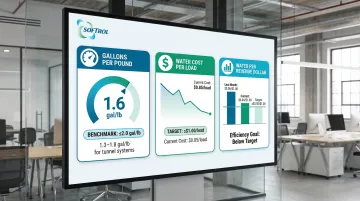
Document Baseline Water Consumption
Before implementing any changes, document existing usage across three dimensions:
- Equipment-specific consumption: Identifies which machines use the most water
- Shift-based patterns: Reveals whether one crew consistently uses more than another
- Seasonal variations: Accounts for demand swings that skew monthly comparisons
Pull at least 12 months of utility bills to capture this variability. That baseline is what makes ROI calculations credible when conservation investments go up for review.
ROI and Implementation Considerations for 2026
Calculate Total Cost of Ownership
Beyond equipment purchase, include installation, training, maintenance, and integration costs. Factor in comprehensive savings:
- Water and sewer cost reduction
- Energy savings from reduced hot water use
- Potential chemical savings from optimized dosing
- Extended linen life from gentler washing
- Reduced labor from automation
Prioritize Investments Based on Facility-Specific Factors
High-volume operations (2,000+ lbs/hour) see faster payback from tunnel washers or recycling systems — typically 1-2 years. Smaller facilities often get better ROI from operational improvements and monitoring technology first. Equipment upgrades follow once data identifies where the return is strongest.
Research Available Incentives and Rebates
Many water utilities and energy efficiency programs offer rebates for high-efficiency commercial laundry equipment. Examples include:
- $125 per qualifying washer for coin laundries
- Up to $1,000 per eligible commercial washer for other facilities
- Custom rebates for water recycling systems based on projected savings
These incentives can reduce upfront costs by 15-30%, which tightens payback timelines considerably.
Plan Implementation in Phases
Incentives are most effective when paired with a structured rollout. Phasing your investment manages capital requirements and keeps operations running during upgrades:
- Monitoring First: Install data collection tools to identify your highest-impact opportunities (1-3 months)
- Quick Wins: Act on low-cost operational changes the data reveals — no capital required
- Targeted Upgrades: Fund equipment improvements in the areas with proven ROI (6-18 months out)
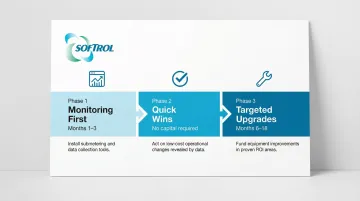
Facilities that follow this sequence typically fund later phases with savings from earlier ones — making the investment largely self-financing by Phase 3.
Conclusion
Water conservation in industrial laundries is not about sacrificing cleaning quality but about eliminating waste through smarter equipment choices, optimized operations, and data-driven decision making. The technologies and practices available in 2026 make 40–60% water reduction achievable for most facilities while improving operational efficiency and cutting operating costs.
Start by benchmarking your current consumption against industry norms — most facilities discover 20–30% in low-cost savings before any capital investment.
Facilities that follow through on the full approach capture real cost savings, shrink their environmental footprint, and stay ahead of rising utility rates before those costs become a competitive disadvantage.
Frequently Asked Questions
What are the techniques for industrial water conservation?
Industrial water conservation covers three main categories: equipment upgrades (high-efficiency washers, tunnel systems, water reclamation units), operational optimization (load capacity, soil-based sorting, cycle and temperature selection), and monitoring technology (submetering, automated chemical dosing, real-time tracking). Facilities that integrate all three consistently achieve the steepest reductions in water use.
Can an industrial laundry facility recycle water?
Yes. Simple systems reuse final rinse water for the next pre-wash, saving 10-35% of total water with minimal treatment. Comprehensive systems filter and treat all wastewater for reuse across every wash stage, achieving 80-85% savings. The right choice depends on facility volume, available capital, and local water rates.
How much water does an industrial laundry facility use per day?
Usage varies by facility size and equipment type. Standard commercial washers run 15-50 gallons per load; a mid-size plant processing 500-1,000 lbs daily typically uses 1,500-4,000 gallons (roughly 3-4 gallons per pound). High-efficiency operations at the same volume cut that figure to 750-2,000 gallons daily.
Do commercial washing machines use more water?
Older commercial top-load machines use significantly more water (35-50 gallons per cycle) than modern high-efficiency front-load commercial washers (15-25 gallons per cycle). Equipment age and type matter more than the commercial versus residential designation. Modern commercial equipment with ENERGY STAR certification uses 45% less water than standard commercial models.
What is the laundry management process?
The workflow moves from soil-level sorting and fabric classification through program selection (cycles, temperature, water levels), loading to 80-85% capacity, and automated chemical dispensing matched to each load. Advanced facilities use centralized management software to track and adjust these parameters in real time.
How much does a grey water recycling system cost?
Simple rinse-water reclaim systems run $15,000-$40,000 installed; comprehensive treatment systems for large facilities range from $75,000-$200,000. Payback typically occurs within 1-3 years depending on water rates and volume — high-usage facilities in high-rate markets often recover costs in under a year.