
Introduction
Typical loss rates for uniforms and linens run between 15% and 20% annually, while median profit margins for industrial rental operators sit at approximately 9.9%. For an operation running on margins that thin, garment loss isn't a rounding error — it's a structural threat.
For a facility managing 10,000 garments in circulation, a 15% annual loss rate means 1,500 missing items — potentially $15,000 to $30,000 in direct replacement costs monthly, before factoring in customer disputes, emergency replenishment, or the labor hours spent chasing missing inventory.
Uniform rental management costs extend beyond washing and delivery. Loss, theft, tracking failures, and inefficient processes create hidden margin erosion that compounds over time. Up to 90% of customer disputes stem from inaccurate tracking, and emergency replacement purchases typically run 20-30% more than planned procurement — two costs that hit simultaneously when visibility breaks down.
While some loss is inevitable in high-volume operations, most margin pressure comes from poor visibility, manual tracking systems, and reactive rather than proactive management. What follows breaks down where those costs actually originate and what leading textile rental companies are doing to stop the bleed.
Key Takeaways
- RFID tracking cuts loss rates to under 3% — vs. the 15-20% industry average
- Automated sorting reduces labor costs 30-40% by eliminating manual handling errors
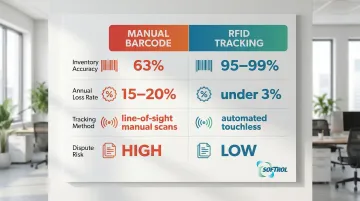
- RFID achieves 95-99% inventory accuracy; manual barcode systems average just 63%
- Closing the gap to top-quartile loss performance adds 2-4 margin points
- Most automation investments pay back within two years via loss reduction and labor savings
How Costs Around Uniform Rental Management Typically Build Up
Uniform rental costs accumulate through channels that often stay invisible until they reach critical mass. Garment loss starts when items leave the facility, compounds through tracking failures during return and processing, and ends with replacement costs for items damaged beyond repair or simply unaccounted for.
These losses operate on two distinct timelines. Gradual losses occur through steady shrinkage—a consistent 1-2% monthly disappearance rate that seems manageable in isolation. Episodic losses strike when customers close accounts without returning inventory, major tracking failures occur during system transitions, or sorting errors send entire batches to wrong destinations.
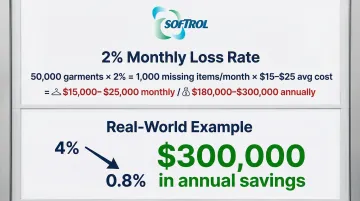
The scale effect amplifies these costs fast. A 2% monthly loss rate across 50,000 garments means 1,000 missing items every month. At an average replacement cost of $15 to $25 per garment, that's $15,000 to $25,000 in monthly margin erosion: $180,000 to $300,000 annually. One hospital reduced annual losses by $300,000 by dropping their loss rate from 4% to 0.8%, demonstrating how seemingly small percentage improvements translate to substantial financial impact.
Replacement garments are only part of the story. The downstream effects compound the financial damage further:
- Overwashing remaining stock when par levels drop, accelerating wear and reducing garment lifespan
- Rushing emergency replenishment orders at premium prices to maintain service levels
- Absorbing labor hours spent searching for missing items and reconciling inventory discrepancies
- Navigating billing disputes over items that can't be proven delivered or returned
Key Cost Drivers for Uniform Rental Management
Garment loss and margin erosion stem from five primary factors that vary in impact depending on operation size, customer mix, and management systems.
Garment Shrinkage and Theft
Customer site losses represent the largest single source of shrinkage. Employees take uniforms home and forget to return them, items disappear during facility closures or staff terminations, and inadequate security at customer locations creates additional exposure.
In uniform rental specifically, "underwash" scenarios are a compounding problem: when 25-50% of employees fail to return soiled garments regularly, those accumulated items are rarely recovered once an employee leaves.
Tracking and Visibility Gaps
Manual barcode scanning systems achieve only 63% inventory accuracy due to missed scans, damaged labels, and line-of-sight requirements. This creates blind spots where operators cannot pinpoint when or where items go missing. Facilities relying on bulk counts instead of item-level tracking often don't detect individual garment losses until they're severe enough to disrupt service.
Sorting Inefficiencies
Labor-intensive manual sorting generates errors at several points in the workflow:
- Garments misrouted to the wrong customer accounts
- Items placed in incorrect size or style categories
- Garments bypassing quality checkpoints entirely
Correcting these mistakes consumes labor time and drives indirect costs — customer dissatisfaction, potential chargebacks, and strained relationships.
Replacement Cycle Management
Reactive purchasing when inventory runs low leads to emergency orders at higher costs and potential service disruptions while waiting for delivery. When operators lack lifecycle data, they're left guessing — discarding serviceable items too early or running garments past acceptable quality thresholds.
Customer Disputes and Chargebacks
Disagreements over missing items, damaged goods, or count discrepancies force operators into a difficult position: absorb the cost to preserve the relationship, or enforce charges without documentation to back the claim. When delivery and return verification isn't recorded, disputes become unresolvable — damaging trust on both sides regardless of who's right.
Cost-Reduction Strategies for Uniform Rental Management
Effective strategies address loss and margin improvement at three levels: procurement and contracting decisions, day-to-day operations management, and the technology infrastructure connecting all processes.
Procurement and Contracting Decisions
Implement risk-based customer qualification: Assess customer locations for security measures, access controls, and historical loss patterns before accepting accounts. Adjust pricing structures or deposit requirements for higher-risk customers such as facilities with high employee turnover, multiple access points, or inadequate return procedures.
Optimize garment specifications and durability: Select fabrics and construction quality that balance upfront cost with expected lifecycle. A garment costing $5 more but lasting 30% longer delivers better total cost of ownership than cheaper alternatives requiring frequent replacement.
Structure contracts with loss accountability: Include clear terms defining customer responsibility for missing items, establish par levels with documented baselines, implement count verification procedures at each exchange, and define chargeback policies with specific dollar amounts and dispute resolution processes.
Design route and service frequency strategically: Align pickup schedules with customer usage patterns to minimize time garments spend at customer sites where loss risk is highest. More frequent service cycles reduce the number of items in circulation at any time, lowering exposure to loss events.
Day-to-Day Operations Management
Implement systematic tracking at every touchpoint: Establish count verification when items leave the facility, when they return from customers, during sorting processes, and before reissue to create accountability chains. Document discrepancies immediately rather than discovering them weeks later when root causes cannot be determined.
Deploy RFID technology for real-time visibility: RFID systems achieve 95-99% inventory accuracy compared to 63% with manual barcode scanning, and operations implementing RFID have reduced loss rates from 15% to under 3%. Softrol's SofTrak system tracks individual garments across their full lifecycle — from initial issue through return processing — while integrating purchasing, invoicing, and customer reporting.
Standardize sorting and processing workflows: Reduce manual handling errors through consistent procedures, quality checkpoints at each processing stage, and automated sorting systems that route garments correctly and flag anomalies. Automated sorting can reduce labor time by 30-40% while eliminating human error.
Create proactive replacement protocols: Use real-time inventory data to trigger reorders before stockouts occur, maintain optimal par levels based on actual usage patterns, and replace aging garments before they fail at customer sites. Without this buffer, facilities often overwash the remaining stock to compensate — accelerating wear and compounding the shortage.
Technology and Infrastructure
Integrate plant-wide data systems for holistic visibility: Connect tracking, processing, customer management, and inventory systems to surface loss patterns and efficiency gaps in real time. Softrol's LOIS (Laundry Operation Information System) gives operators remote access to plant performance data from any device, with email alerts and 24/7 monitoring of critical functions.
Automate material handling and sorting infrastructure: Conveyor systems, automated sorting, and integrated controls cut labor costs while improving throughput accuracy. Mission Linen reduced sorting labor by 77% using Softrol's SoftSort Autosortation System, processing 3,500 garments per hour with a fraction of the previous workforce.
Establish customer communication and education programs: Train customer staff on proper uniform handling, return procedures, and loss prevention practices to reduce shrinkage at the source. Provide customers with transparent, data-backed reports on their usage and loss patterns to encourage better internal controls and accountability.
Implement predictive analytics and benchmarking: Analyze historical data to identify loss trends by customer, location, garment type, and time period. Compare performance against industry benchmarks to identify improvement opportunities, and target initiatives where they will have the greatest margin impact based on actual data rather than assumptions.
Conclusion
Reducing loss and boosting margins in uniform rental management depends on identifying where loss originates—whether at customer sites, during processing, or through system gaps—not just cutting costs indiscriminately. The gap between industry-average 15-20% loss rates and top-performer rates under 3% translates directly into millions of dollars for mid-sized operations.
The most successful textile rental companies treat loss reduction as a strategic priority—not an afterthought—anchored in technology investment, process discipline, and customer accountability. The numbers make the case on their own:
- 15–20% average industry loss rate vs. under 3% for top performers
- 2–4 percentage points of margin improvement from systematic loss management
- Two-year payback periods on tracking and automation investments
Operations that achieve these results don't accept shrinkage as inevitable. They build systems—garment tracking, automated sortation, real-time data—that make loss visible, measurable, and controllable. That's where the margin gains actually come from.
Frequently Asked Questions
What is the average garment loss rate in textile rental operations?
Industry averages range from 15-20% annually for operations using manual or barcode tracking systems. Top-performing operations maintain loss rates under 3% through systematic RFID tracking, automated sorting, and proactive management practices.
How does RFID tracking reduce uniform loss compared to barcode systems?
RFID enables automated, touchless tracking at multiple processing points without requiring line-of-sight scanning. This delivers 95-99% accuracy versus 63% with manual barcode systems — where damaged labels and human error routinely cause missed scans.
What are the biggest sources of garment shrinkage in uniform rental?
Three sources account for the majority of shrinkage:
- Customer site loss — items taken home, stolen, or not returned at termination
- Processing errors — misrouting during sorting or delivery to the wrong customer
- Tracking failures — no visibility into when or where items disappeared
How quickly can textile rental companies see ROI on tracking automation?
Most operations recover their investment within 18-24 months. The combined gains — a 12-15 percentage point drop in loss rates, 30-40% less sorting labor, and fewer billing disputes — stack up quickly.
What margin improvement is realistic from better loss management?
Companies typically improve margins by 2-4 percentage points by reducing loss rates from industry average (15-20%) to top-quartile performance (under 3%). For a facility processing $5 million annually, this represents $100,000-200,000 in additional profit.
How do you handle customer disputes over missing garments?
Set clear contract terms defining loss responsibility upfront. Then back every pickup and delivery with documented scan records showing exactly what was delivered and whether it came back — this approach eliminates up to 90% of retrospective complaints.