
Introduction
Picture this: It's Friday night at 6:00 PM, and your dining room is about to fill with reservations. Your servers arrive for their shift, but half the team is scrambling because clean uniforms are nowhere to be found. Some are mismatched, others are missing entirely, and one server is sent home because there's no uniform available in their size. This isn't just an inconvenience—it's a costly operational failure that impacts service quality and customer perception.
Manual uniform tracking creates this kind of chaos routinely. Without a reliable system, the same problems surface again and again:
- Over-ordering inventory "just in case," yet still running short during peak periods
- No clear accountability when uniforms disappear between shifts
- Unexpected replacement costs eating into already thin margins
- Appearance inconsistencies that signal poor hygiene standards to customers
Garment tracking systems give food service operators a direct line of sight into where every uniform is, who has it, and whether it's clean. What follows covers how the technology works, what it costs, and how to put a system in place that keeps your team looking sharp without the guesswork.
TLDR:
- RFID and barcode tracking cut uniform loss rates from 10–15% down to under 3%
- Real-time dashboards show inventory levels, garment location, and wash cycle status
- Most operations recover implementation costs within 12–18 months through replacement and labor savings
- Automated logs create audit-ready records for health code and HACCP compliance
- Staff reliably receive clean, properly sized uniforms before every shift
What Is Garment Tracking for Food Service Uniforms?
Garment tracking is a systematic method of monitoring uniform inventory throughout its entire lifecycle using embedded technology. The most common tracking methods use RFID tags, barcodes, or QR codes sewn or heat-sealed directly into garments. Each tag contains a unique identifier that links to a database record containing the garment's assignment history, cleaning cycles, condition reports, and replacement schedule.
Manual and automated tracking produce very different outcomes. Manual methods rely on spreadsheets, paper sign-out sheets, and visual inventory counts. These approaches typically achieve accuracy rates below 70%, meaning nearly one-third of your inventory is unaccounted for at any given time. Employees forget to log returns, uniforms get mixed up between locations, and managers spend hours reconciling discrepancies.
Automated tracking systems eliminate these gaps by capturing data at every touchpoint:
- Pickup: The system logs each garment when an employee checks it out
- Collection: Soiled uniforms are scanned when retrieved for cleaning
- Processing: Items are tracked through washing, inspection, and quality checks at the laundry facility
- Return: Delivery is confirmed, with each garment matched back to the correct employee
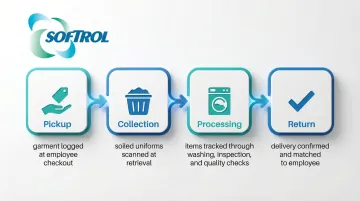
The result is a complete, auditable record for every uniform — from first pickup to final return.
Why Garment Tracking Matters for Restaurants and Food Service
The Unique Challenges of Food Service Uniforms
Restaurants face distinct uniform management challenges that make tracking essential. The projected annual turnover rate for the restaurant industry in 2025 is 61.7%, creating a constant cycle of issuing and retrieving uniforms. When employees leave without returning items, manual systems often fail to flag missing assets immediately, resulting in significant losses.
Food service operations compound this challenge. Each employee typically needs multiple garment types:
- Chef coats, server aprons, pants, and position-specific attire
- Each item tracked separately, multiplying inventory complexity
- Uniforms cycling through cleaning multiple times per week — creating more opportunities for loss or mix-ups
The cost impact is substantial. Traditional manual tracking systems commonly experience uniform loss rates of 10-15%. For a restaurant with 50 employees and $100 worth of uniforms per person, that's $500-$750 in annual losses—before accounting for replacement labor costs and operational disruptions.
Health Code and Hygiene Compliance
The FDA Food Code explicitly mandates that food employees "shall wear clean outer clothing to prevent contamination of food, equipment, utensils, linens, and single-service and single-use articles". While health codes don't specify exactly how often uniforms must be laundered, operators must demonstrate that garments meet cleanliness standards appropriate to the soil level and contamination risk.
Garment tracking systems create audit-ready documentation by logging exactly when each uniform was cleaned and returned. This data supports HACCP prerequisite programs for personal hygiene, which form the foundation of food safety management. During health inspections, you can provide concrete evidence showing uniform sanitation protocols are actively managed and verified, not just documented on paper.
Professional Appearance and Brand Consistency
Customers associate staff attire with your restaurant's cleanliness and reliability. A clean, well-fitted uniform signals competence and adherence to safety standards. Dirty or disheveled uniforms suggest unhygienic practices and can severely damage brand trust.
Tracking systems ensure all staff have complete, well-maintained uniforms that represent your brand standards. The technology prevents the "mixed bag" look that occurs when employees are forced to wear mismatched or worn-out substitutes due to shortages. By monitoring garment condition and flagging items for repair or retirement, you maintain consistent professional appearance across all shifts and locations.
Operational Efficiency During Peak Service
Uniform shortages during busy shifts hit hardest when you can least afford it. Delayed shift starts cut floor coverage at peak demand. Staff sent home for missing attire means scrambling to cover sections — or turning away reservations. During special events or seasonal rushes, that can mean thousands in lost revenue.
Tracking prevents service disruptions by ensuring adequate inventory levels and proper distribution. Real-time visibility shows exactly what's available, what's in the cleaning cycle, and when items will return. This allows managers to plan proactively rather than react to crises, ensuring every employee has proper attire when they clock in.
How Garment Tracking Systems Work
RFID Technology Explained
RFID (Radio Frequency Identification) tags are small chips embedded in uniform garments during manufacturing or retrofitted through heat-sealing or sewing. Industrial RFID laundry tags are engineered to withstand over 200 wash cycles, surviving high heat (washing at 75-90°C), chemical exposure, and mechanical stress from industrial extraction.
Each tag stores a unique identifier that links to database records containing:
- Garment ID and type (chef coat, server apron, etc.)
- Employee assignment history
- Cleaning cycle count and dates
- Purchase date and expected lifecycle
- Condition reports and repair history
The scanning process uses radio waves to read tags without requiring line-of-sight. Unlike barcodes that must be individually scanned, RFID readers can capture data from hundreds of garments simultaneously as they pass through doorways, on conveyor systems, or in bulk carts. This enables processing rates of up to 3,800 garments per hour with minimal manual intervention.
The Tracking Workflow
The journey of a tracked uniform follows this path:
- Initial Tagging and Assignment - New uniforms receive RFID tags and are assigned to specific employees in the system
- Employee Wears Garment - The system records when the uniform is checked out for use
- Soiled Uniform Collected - Used garments are scanned during collection, logging return and soil level
- Scanned at Laundry Facility - Items are tracked upon arrival at the cleaning facility
- Cleaned and Inspected - Post-cleaning scans verify proper processing and flag items needing repair
- Scanned for Delivery - System confirms items are loaded for return to the correct location
- Returned to Correct Employee - Final scan documents delivery and makes the uniform available for checkout
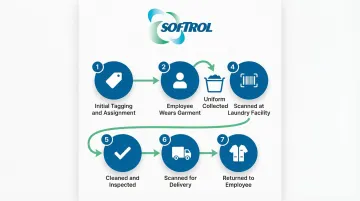
Throughout this workflow, the system automatically flags issues. Missing garments trigger alerts when they don't appear at expected checkpoints. Excessive wear is identified when inspection scans note damage or deterioration. Overdue cleaning cycles are flagged when items remain checked out beyond policy limits.
Data and Reporting Capabilities
Modern tracking systems give restaurant managers a clear operational picture across four key metrics:
- Inventory levels — exactly how many uniforms are available, in use, being cleaned, or awaiting repair, eliminating the guesswork that causes overstocking or shortages
- Location status — where each item sits at any moment: on an employee, in a soiled cart, at the laundry facility, or in clean inventory
- Cleaning frequency — how often each garment is laundered, supporting compliance documentation and predicting replacement needs based on actual wear
- Cost per garment — total lifecycle costs covering purchase price, cleaning expenses, repairs, and replacement frequency for smarter procurement decisions
Cloud-based systems allow managers to access this data from anywhere using smartphones, tablets, or computers. Softrol's LOIS (Laundry Operation Information System) provides 24/7 access to plant performance data, real-time email alerts, and customizable dashboards for monitoring multiple locations from a single account.
Integration with Uniform Service Providers
Whether uniforms are managed in-house or through a commercial laundry service, tracking systems connect to both operational models. For outsourced programs, the technology creates clear accountability on both sides of the relationship.
Commercial laundries using Softrol's SofTrak RFID system integrate tracking with automated sorting and cleaning processes. Each garment moves through the facility without manual intervention:
- Identified and sorted by customer and garment type
- Routed to the appropriate cleaning equipment
- Verified and confirmed before loading for delivery
This cuts processing time, eliminates sorting errors, and gives restaurant customers detailed reporting on their uniform program.
For restaurants managing uniforms internally, tracking systems connect with existing inventory management and employee scheduling software, creating a unified view of uniform availability aligned with staffing needs.
Key Benefits of Implementing Garment Tracking
Reduced Uniform Loss and Theft
Accountability through tracking dramatically reduces lost garments. Deploying RFID tracking has been proven to reduce uniform loss rates from a baseline of 10-15% down to under 3%. This reduction happens because every garment is associated with a specific employee. If a uniform doesn't return, the system identifies exactly who was last responsible, enabling immediate follow-up.
For a 50-employee restaurant with $5,000 in total uniform inventory, reducing loss from 12% to 3% saves $450 annually in direct replacement costs—and that's before accounting for the labor savings from eliminating manual reconciliation efforts.
Lower Replacement and Inventory Costs
Tracking extends garment lifespan by documenting maintenance needs and enabling timely repairs before damage becomes severe. Systems monitor wash cycle counts and flag items approaching end-of-life thresholds, allowing planned replacement rather than emergency purchases.
Case studies show reductions in annual uniform purchasing costs of up to 45% when facilities transition from manual to automated tracking. Additionally, inventory levels can be reduced by 30-50% by eliminating "hoarding" behavior where employees keep extra uniforms in lockers and ensuring efficient rotation of available stock.
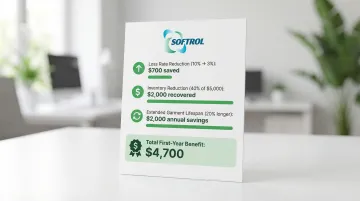
Example Calculation:
- Current annual uniform cost: $10,000
- Loss rate reduction: 10% → 3% = $700 savings
- Inventory reduction: 40% of $5,000 = $2,000 one-time capital recovery
- Extended lifespan (20% longer): $2,000 annual savings
- Total first-year benefit: $4,700
Improved Inventory Management
Real-time visibility prevents both overstocking (which ties up capital in unused assets) and understocking (which causes operational disruptions). Tracking data reveals actual usage patterns, showing which uniform types and sizes have highest turnover and which sit unused.
That data optimizes inventory levels based on reality rather than guesswork. Managers can identify seasonal patterns, predict replacement needs for high-turnover positions, and ensure adequate supply for new hires without maintaining excessive safety stock.
Enhanced Employee Accountability
Tracking systems create clear ownership of uniforms, reducing disputes about lost or damaged items. When employees know each garment is assigned to them individually and the system tracks checkout/return cycles, uniform care improves noticeably.
Termination processes benefit just as much. The system automatically flags unreturned uniforms when employees leave, enabling immediate recovery before items disappear permanently. Some operations deduct uniform costs from final paychecks when items aren't returned—a practice you can only justify with documented tracking data.
Streamlined Compliance Documentation
Automated tracking creates comprehensive audit trails for health inspections without additional labor. Instead of manually logging cleaning schedules and hoping records are complete during inspections, you can instantly generate reports showing:
- When each uniform was last cleaned
- Cleaning frequency for all active garments
- Documentation that soiled uniforms are removed from service
- Verification that staff have access to adequate clean uniforms
When an inspector walks in, that report is ready in seconds—no scrambling through paper logs or spreadsheets.
Better Workforce Planning
Tracking data reveals operational patterns that inform strategic decisions. Rather than reacting to shortages, managers can anticipate them—using historical data to plan ahead for:
- High-turnover positions with above-average wear rates
- Peak hiring periods that spike new-uniform demand
- Special events or catering operations requiring temporary inventory increases
- Annual budget forecasting based on actual usage, not estimates
Seasonal patterns become visible over time, turning uniform program management from guesswork into a predictable, data-driven process.
Choosing the Right Tracking System for Your Restaurant
Assess Your Operation's Needs
Start by evaluating your specific requirements:
Key Questions to Answer:
- How many employees need uniforms across all locations and shifts?
- What types of uniforms do you use (chef coats, server shirts, aprons, pants)?
- What's your current annual uniform spending and replacement frequency?
- How many uniforms go missing each month?
- What's your employee turnover rate?
- Do you manage laundry in-house or outsource to a service provider?
- How much staff time currently goes to uniform management?
Calculate your baseline costs to establish ROI expectations. If you're spending $15,000 annually on uniforms with 12% loss rates and 10 hours per week on manual tracking, you have clear targets for improvement.
Technology Options and Considerations
| Technology | Key Advantages | Limitations | Best Fit |
|---|---|---|---|
| RFID | No line-of-sight required; bulk reading; 200+ wash cycle durability; full automation capable | Higher tag cost ($1–$3 each); requires specialized readers | High-volume operations, commercial laundry partnerships, multi-location restaurants |
| Barcode | Low initial cost; familiar technology; simple to implement | Requires line-of-sight; labels fade; labor-intensive; limited durability | Smaller operations with in-house management and tight budgets |
| QR Code | Smartphone-scannable; moderate cost; easy rollout | Requires line-of-sight; manual scanning; moderate durability | Small to mid-size operations wanting mobile-friendly solutions |
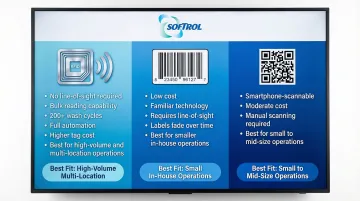
For commercial laundry environments, RFID is the industry standard — its durability and bulk-reading capability keep pace with volume in ways barcode systems simply can't match at scale. That performance gap matters most when selecting a provider to partner with.
Working with Uniform Service Providers
The right provider handles the technology infrastructure, so your team focuses on running the restaurant rather than managing spreadsheets. Integrated systems connect tracking directly to sorting, cleaning, and delivery — eliminating manual handoffs that create errors.
What to Look for in a Provider:
- Proven RFID or tracking technology with documented durability
- Industry experience specifically in food service or hospitality
- Comprehensive support services including installation, training, and 24/7 technical assistance
- Robust reporting capabilities with web-based access
- Scalability to accommodate business growth
- Integration capabilities with your existing systems
Softrol's SofTrak system, for example, combines RFID tracking with automated sorting that processes up to 3,800 garments per hour — reducing labor requirements by up to 77% while giving operators real-time visibility into where every uniform stands.
Frequently Asked Questions
How to track uniform inventory?
Modern uniform inventory tracking uses RFID tags or barcodes embedded in garments, scanned at key points—assignment, pickup, cleaning, and delivery—to maintain real-time visibility of each item's location and status throughout its lifecycle.
What is the meaning of garment management?
Garment management is the comprehensive process of procuring, distributing, maintaining, tracking, and replacing workplace uniforms to ensure employees always have appropriate, clean, and professional attire that meets operational and compliance standards.
What is the uniform policy for restaurants?
Restaurant uniform policies typically specify required attire by position (chef coats, server shirts, aprons), appearance standards (cleanliness, fit, condition), and responsibilities regarding who provides uniforms, who handles cleaning, and how replacements are managed.
What does HACCP compliant mean?
HACCP-compliant uniforms meet the documented cleaning and sanitation standards required by the Hazard Analysis Critical Control Points food safety framework. Tracking systems provide the audit trail needed to verify proper laundering protocols and demonstrate compliance during inspections.
What's the ROI of a garment tracking system for restaurants?
ROI comes from reduced uniform loss (typically 15–30%), lower replacement costs, decreased inventory labor, and fewer compliance issues. Payback periods often fall within 12–18 months, with larger operations seeing faster returns due to higher transaction volumes.
What technology is used in garment tracking systems?
The three main options are RFID chips, barcodes, and QR codes. RFID dominates commercial laundry environments because it withstands 200+ industrial wash cycles, reads in bulk without line-of-sight, and requires no manual handling—making it the most practical choice for high-volume uniform programs.