83% of industrial decision-makers report that unplanned downtime costs at least $10,000 per hour, with some facilities facing losses up to $500,000 per hour. When your control system fails, it doesn't matter how sound your washer's drum and frame are—production stops. Legacy controls lack the processing power, connectivity, and diagnostic capabilities required for modern efficiency standards, creating bottlenecks that impact your competitive position and ability to meet client demands.
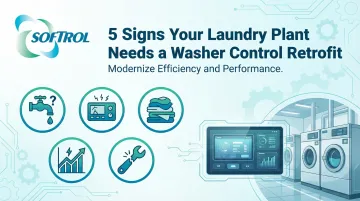
TLDR: 5 Critical Signs Your Laundry Plant Needs a Washer Control Retrofit
- Control failures are causing unplanned downtime that disrupts production schedules
- No visibility into cycle counts, water usage, or production rates for client reporting
- Utility costs keep climbing despite stable production volumes
- Replacement parts face 4-6 week lead times — or are discontinued entirely
- Manual programming and monitoring are driving up labor costs and operator errors
Sign #1: Frequent Unplanned Downtime and Control System Failures
The Symptoms
Your washers stop mid-cycle with no clear explanation. Error codes flash on displays that offer no meaningful diagnosis. Controllers freeze and require frequent reboots. These aren't mechanical failures—your drum, bearings, and seals are fine. The problem is electronic: aging circuit boards, degraded capacitors, and outdated relay systems that lack self-diagnostic capabilities.
Legacy control systems fail silently. Unlike mechanical breakdowns where you can hear a bearing grinding or see a belt slipping, electronic failures present as the machine simply stopping or behaving erratically. Common technical causes include:
- Proprietary control boards aging out, with capacitors and relays failing intermittently
- Data cable faults between the main controller and VFDs, surfacing as "No Comm" or "I2C Bus Error" codes
- Touchscreen and keypad wear from constant physical use in heat, humidity, and chemical-heavy environments
The Business Impact
Unplanned downtime costs industrial laundries between $10,000 and $500,000 per hour, depending on facility size. A single tunnel washer failure can halt your entire wash aisle. When one washer goes down, it creates bottlenecks throughout the production line—clean goods pile up waiting for dryers, soiled goods accumulate at the tunnel entrance, and your entire schedule falls behind.
In one documented case, a predictive maintenance pilot prevented 28 hours of unplanned downtime over three months, avoiding approximately $14,000 in direct costs—not counting the schedule disruptions and customer service strain that followed.
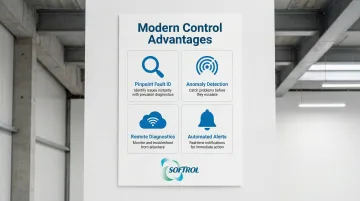
Modern Control Advantages
That's exactly where a control retrofit pays for itself. Modern controllers like Softrol's MicroPulse platform shift the maintenance model from reactive to predictive. Instead of waiting for a failure, the system tells you what's about to fail—and when.
Key capabilities include:
- Pinpoint fault identification ("Door Lock Fault" rather than a generic "System Error")
- Anomaly detection that catches cycle deviations before they become full stops
- 24/7 remote diagnostics that cut mean time to repair
- Automated alerts pushed directly to maintenance teams the moment intervention is needed
Sign #2: No Access to Real-Time Operational Data or Performance Metrics
The Problem
Your plant managers make decisions based on manual logs, clipboards, or gut feeling. Operators handwrite production numbers throughout their shifts. You have no visibility into what's happening on the floor unless you're physically standing there. When clients ask for performance reports or proof of wash quality standards, you scramble to compile data from multiple sources—if you have it at all.
That data blindness is a real competitive disadvantage. Without reliable metrics, inefficiencies go undetected, scheduling stays guesswork, and healthcare or hospitality clients have no performance transparency to point to when they ask for it.
What Modern Systems Provide
Modern IoT-enabled controls deliver real-time operational data including:
- Cycle counts per machine, per shift, and per day
- Water and chemical usage broken down by load type
- Temperature profiles logged throughout each wash cycle
- Machine utilization rates that surface underperforming equipment
- Access from smartphones, tablets, and PCs — so data follows you off the floor
Softrol's LOIS (Laundry Operation Information System) puts this into practice, offering 24/7 access to critical plant performance data from any location. The system sends real-time alerts directly to email addresses and tracks employee performance, machine utilization, and production metrics continuously.
Facilities utilizing smart controls report a 20% boost in output and 30% increase in laundry volume without increasing operational costs.
Compliance and Audit Challenges
Those output gains matter — but for healthcare and hospitality clients, the compliance story matters just as much. The Healthcare Laundry Accreditation Council (HLAC) and ALM guidelines mandate documented verification of temperature, time, and chemistry for every load. Legacy systems with manual data collection make that nearly impossible to prove.
Modern controls automatically log cycle data, creating a permanent, tamper-proof audit trail. When an inspector asks for heated water temperature records or chemical delivery calibration logs, you pull a report — you don't reconstruct one from handwritten notes.
Sign #3: Escalating Energy and Utility Costs
Sign #3: Escalating Energy and Utility Costs
The Symptom
Your utility bills trend upward despite stable production volumes. You haven't added equipment or increased throughput, yet water, gas, and electricity costs keep climbing. The culprit is often outdated controls that can't optimize resource consumption.
Root Causes
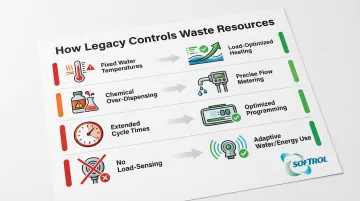
Legacy control systems waste resources in multiple ways:
- Inability to optimize water temperature - mechanical timers heat water to fixed temperatures regardless of load requirements
- Over-dispensing chemicals - without precise flow metering, systems default to maximum doses
- Extended cycle times - outdated programming runs longer cycles than necessary
- Lack of load-sensing - systems use the same water and energy for half-loads as full loads
The Efficiency Gap
Retrofitting controls can reduce hot water energy requirements by up to 65% through precise temperature management. Smart controls with load-sensing technology reduce water usage by 34% by adjusting water levels to match actual load size.
Modern controls with precise chemical injection cut waste and improve wash quality. Automated dosing delivers the right amount of chemical for each load type — and better control integration reduces chemical costs by up to 12%.
Environmental and Regulatory Pressures
Those efficiency gains matter beyond the bottom line. Water conservation mandates and sustainability reporting requirements are pushing commercial laundries to modernize. Programs like EPA WaterSense promote water-efficient equipment, while state regulations and corporate sustainability frameworks demand precise utility data — something legacy controls simply can't deliver.
Retrofitting with water recycling systems managed by advanced controls can save 50% to 80% of water consumption.
Sign #4: Obsolete Parts and Vanishing Technical Support
The Challenge
You call for service only to learn replacement parts are discontinued. Or they're available — but with 4–6 week lead times. Meanwhile, your washer sits idle, production falls behind, and you're stuck in reactive "find any solution" mode rather than planned upgrades, often at premium emergency pricing.
Legacy or discontinued parts can have lead times of 4 to 6 weeks or may be completely unavailable. Obsolete parts often carry price premiums of 20–50% due to scarcity.
Vendor Consolidation Impact
The industrial laundry control market has consolidated sharply over the past two decades. Many legacy manufacturers have been acquired or exited the market entirely — and as they disappear, so do the technicians who know those systems. The result is a shrinking pool of specialists familiar with older, niche control platforms, which means longer wait times and higher service costs when something breaks.
The Tipping Point Calculation
Two widely used rules of thumb can help you decide when to stop repairing and start replacing:
- Repair cost threshold: If repair costs approach 50% of a new machine's price, retrofit or replacement is typically the better economic option.
- Annual maintenance cap: Maintenance spending should stay at or below 3% of the asset's replacement value — exceeding this signals the equipment is becoming a liability.
How MicroPulse Solves the Parts Problem
Softrol's MicroPulse controls are built from the ground up for industrial laundry environments, with ongoing support and parts availability that legacy systems can't match. All replacement components are stocked as new OEM parts and typically ship within 24 hours — not weeks.
Every part carries a one-year full-replacement warranty. No refurbished components, no sourcing surprises.
Sign #5: Manual Programming and Monitoring Increases Labor Costs
Labor-Intensive Processes
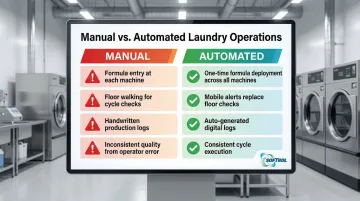
Your operators manually enter formula changes at each machine. They walk the floor checking machines for cycle completion, then handwrite production logs throughout their shifts. These manual processes consume hours of labor every day—labor you could redeploy to higher-value activities.
The Hidden Cost
Calculate the time your operators spend on manual washer monitoring and programming across shift changes. Multiply that by hourly labor costs. The numbers add up quickly. That wasted time also opens the door to costly errors.
Error Risks
Manual processes introduce errors that compromise quality and increase costs:
- Produces inconsistent wash quality when formula settings vary between machines
- Causes production delays when cycle completions go unnoticed
- Prevents real-time adjustments for different soil levels or fabric types
- Creates openings for operator shortcuts that cut corners on quality
In one correctional facility case, inmates intentionally selected shorter cycles to finish early, compromising quality. Retrofitting with controls that locked out inappropriate options eliminated this issue entirely.
Modern Automation Benefits
Automated systems address each of these pain points directly:
- Program formulas once and deploy them across all connected machines simultaneously
- Adjust cycles automatically based on load type and soil level—no operator input required
- Send mobile alerts when intervention is needed, eliminating constant floor checks
- Generate digital production logs automatically, with no handwriting or transcription errors
Softrol's PulseNet Load Management Module allows operators to drag and drop virtual bags into washers on-screen, automatically transferring load data to the selected washer. This eliminates manual programming and ensures consistent formula application across all connected equipment.
Manual processes also cap your growth. As volume increases, you need proportionally more staff just to keep up. At one facility running automated controls, a single operator manages an entire wash aisle from a central PC monitoring station—a role that would require multiple operators under a manual system.
Frequently Asked Questions
How do you know if your washer control board is bad?
Common symptoms in industrial settings include inconsistent cycle execution, failure to advance through programmed steps, error codes without clear diagnosis, inability to communicate with central systems, or physical signs like burnt components or corrosion. Modern systems provide specific fault codes that pinpoint the issue, while legacy systems often fail with generic errors.
Is it worth replacing a control board on a washing machine?
For machines under 10 years old in good mechanical condition, a retrofit is typically the smarter financial move — costing 30-55% of new equipment while delivering 60-70% savings over full replacement. It preserves your existing mechanical investment while adding modern automation capabilities.
How often should you upgrade your washing machine?
Industrial washers last 15-20 years, but control systems should be evaluated every 7-10 years as technology advances. Plan a proactive assessment when three or more signs from this article appear at once — electronic controls typically face obsolescence within 3-5 years of their original design cycle.
What is the life expectancy of a commercial laundry machine?
Quality industrial washers with proper maintenance last 15-20 years, with premium models reaching 20-25 years. Control systems and electronics, however, typically require upgrades at the 7-12 year mark — well before the mechanical components wear out.
What are the major challenges faced by a laundry department?
Outdated controls worsen the most common laundry department pain points:
- Labor costs rising due to manual workarounds
- Inconsistent quality from unreliable cycle execution
- High utility expenses without precise chemical or water control
- Unplanned downtime from failing components
- No data visibility for client reporting or compliance
Modern control systems tackle each of these through automation, real-time monitoring, and comprehensive data logging.